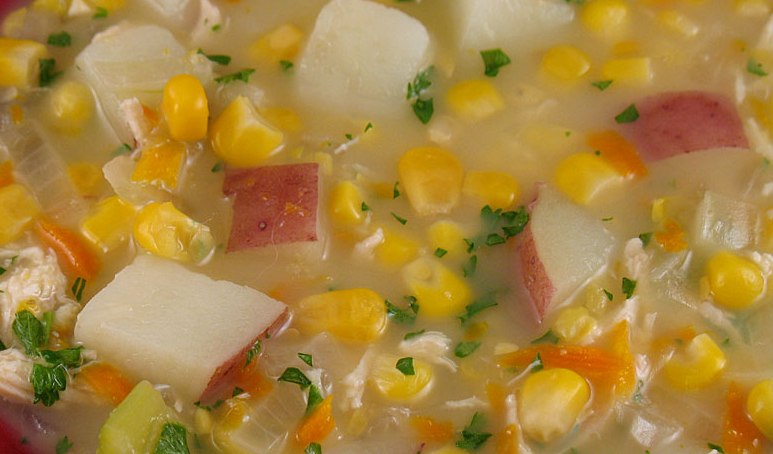
Red Potato, Leek & Corn Chowder

cornchowder

Ingredients:

3 c. diced red potatoes (do not peel)

1 stick butter

1 large onion, minced

2 cloves garlic, minced

1 leek (white part only) sliced

3 scallions, white and green parts, chopped

1/2 t. dry mustard

1/4 t. cayenne pepper

1 t. ground thyme

3 stalks celery, diced

4 cups fresh or frozen whole kernel corn

4 T. flour

4 cups (1 quart) half and half

¼ c. chopped parsley

2 t. honey

¼ t. black pepper

¼ t. salt

¼ t. nutmeg

1 bay leaf

2 cups vegetable stock

Directions:

Parboil potatoes in water for 7-8 minutes until they can be pierced with a fork. Drain and reserve. In a large saucepan, melt 1/2 stick of butter and sauté onions, garlic, leeks, and scallions in remaining 10-15 minutes over medium heat until they are transparent. Season with mustard, cayenne, and thyme. Raise the heat and add celery and corn. Saute for 3-4 more minutes. Add vegetable stock and cook until heated through. Cover and remove from heat.

To make white sauce, in a heavy saucepan, melt the remaining ½ stick butter. Add flour and a pinch of salt. Whisk over low flame for 5 minutes until it is well-blended and forms a paste. Slowly add half and half, stirring constantly for 10 minutes or until thickened.  Stir in parsley, honey, bay leaf, pepper and nutmeg. Add white sauce and potatoes to onion mixture and reheat, if necessary over medium low heat. Adjust seasoning. Makes 3 quarts.

Week 32: Corn

corn

Summer’s harvest wouldn’t be complete without golden ears of corn. Whether roasted on the grill or steamed on the stove, each bite of corn is like a hot, buttered burst of sunshine!

Corn is classified as a grain and was domesticated around 9,000 BC in Central America. It takes its name “maize” from the Spanish word “maiz.” Corn grows on stalks 8-12 ft high as “ears” (cobs covered with individual kernels about the size of peas) which are protected by corn silk and husks. Native Americans first planted maize in raised rows and used the stalks to support beans, which supplied nitrogen and nutrients to the soil. Varieties of squash provided ground cover to stop weeds and inhibit evaporation by providing shade over the soil. Today, corn in North America is planted in rows to allow easier cultivation and with a two-crop rotation, often with alfalfa planted every other year.

U.S. farmers grow about 40% of all corn produced worldwide today. An important region of the U.S. is still identified as the “Corn Belt.” This region is typically defined as including Iowa, Illinois, the eastern parts of Nebraska and Kansas as well as North and South Dakota, the southern part of Minnesota, and parts of northern Missouri as well as Ohio and Indiana. Introduced into Africa by the Portuguese in the 16th century, maize has become Africa’s most important staple food crop.

Most of us are familiar with yellow or white corn, but did you know it can also be blue, black, red, pink or purple? Some varieties of corn are bred to produce the “baby corn” used in Asian cuisine. Corn flour lacks the “gluten” of wheat and produces baked goods which do not rise.

Corn is eaten in a variety of ways and is used to make tortillas, polenta, cornbread, hominy, grits, cereals such as corn flakes, popcorn and chips. Corn is also used to produce high fructose corn syrup (a sugar substitute used in processed foods), corn oil, in fermentation and distilleries for making Bourbon Whiskey, for animal feed, biofuels, home heating and plastics.

Ethanol is being used in concentrations of 10% or less as an additive in gasoline for motor fuels to increase the octane rating, lower pollutants, and reduce petroleum use. Home-heating furnaces have been developed which use corn kernels as fuel. They feature a large hopper that feeds the uniformly sized maize kernels (or wood pellets) into the fire.

The resin polylactic acid (PLA), derived from corn starch, is formed into containers and packaging for food and consumer goods. For a few years, natural foods purveyors such as Newman’s Own Organics and Wild Oats have been quietly using some PLA products, but the material got its biggest boost when Wal-Mart, the world’s largest retailer, announced in 2006 that it would sell some produce in PLA containers. Producing PLA uses 65 percent less energy than producing conventional plastics, it generates 68 percent fewer greenhouse gases, and contains no toxins.

Nutrition

Corn is high in antioxidants, but each variety of corn has a different combination of phytonutrients. Yellow corn has carotenoids and blue corn has anthocyanins. Corn is high in protein and is also a good source of fiber and contains vitamins B6, niacin, phosphorus and manganese. Corn supports the growth of healthy bacteria in our large intestines and helps lower the risk of colon cancer.

High Fructose Corn Syrup

Forty percent of all processed, pre-packaged foods sold in U.S. groceries currently contain some processed component of corn, although this component is most often high fructose corn syrup (HFCS). There is significant concern that high fructose corn syrup contributes to obesity, diabetes, liver disease and heart disease. It is also been shown to have contaminants such as mercury. Because it is less expensive to produce than conventional sugar, it is used extensively in food products today. Did you know there is the equivalent of 17 teaspoons in one 20 oz soft drink?

Genetically Engineered Corn

Over 70% of all corn found in U.S. grocery stores has been genetically modified in the form of herbicide-tolerant, or HT corn, or the form of insect-resistant, or Bt corn. (Bt corn gets its name from the transfer of a gene from the soil bacterium, Bacillus thuringiensis, into the corn. A protein toxin produced by this bacterium helps to kill certain insects that might otherwise eat the corn.) While there is no large scale human research on genetically engineered corn and its health impact, there is concern about the introduction of novel proteins into food and their potential for increasing risk of adverse reactions, including food allergies. One way to avoid these potential risks is to select certified organic corn, since GE modifications are not allowed in certified organic food.

Resources

Mann, Charles. Cotton (or Anchovies) and Maize.

“The casava transformation in Africa”. The Food and Agriculture Organization of the United Nations (FAO).

http://www.smithsonianmag.com

http://www.sweetsurprise.com

http://www.whfoods.com

Salad Nicoise

Salad Nicoise

Ingredients:

Salad

6 medium tomatoes sliced

1 ½ c. green beans, blanched

6 hard-boiled eggs, peeled and quartered

18 marinated artichoke hearts

12 large romaine lettuce leaves, washed

½ head chicory (or assorted salad greens)

1 ½ c. new potatoes, boiled, quartered and chilled

Three 4 oz. ahi tuna steaks or one 12 oz can tuna, packed in olive oil

½ c. Nicoise olives

2 T. extra virgin olive oil (for searing)

Dressing

¼ c. red wine vinegar

1 ½ c. extra virgin olive oil

Salt & Pepper to taste


Directions:

In a skillet over medium high heat, sear tuna steaks for 2 minutes on each side in olive oil. Remove from heat and slice each tuna steak into 1/4 inch slices. Line each cold plate with two romaine lettuce leaves and chicory, and then arrange the remaining ingredients on the lettuce. Overlap the tuna slices down the center of the plate and arrange the other vegetables on either side, using contrasting shapes, colors and textures to create an attractive presentation. (If you are using canned tuna – drain and divide tuna chunks among the plates.) Combine ingredients for dressing in small bowl and whisk until well-blended. Pour approximately ¼ c. of dressing over each salad. Serves 6.


Week 31: Olives

Olives

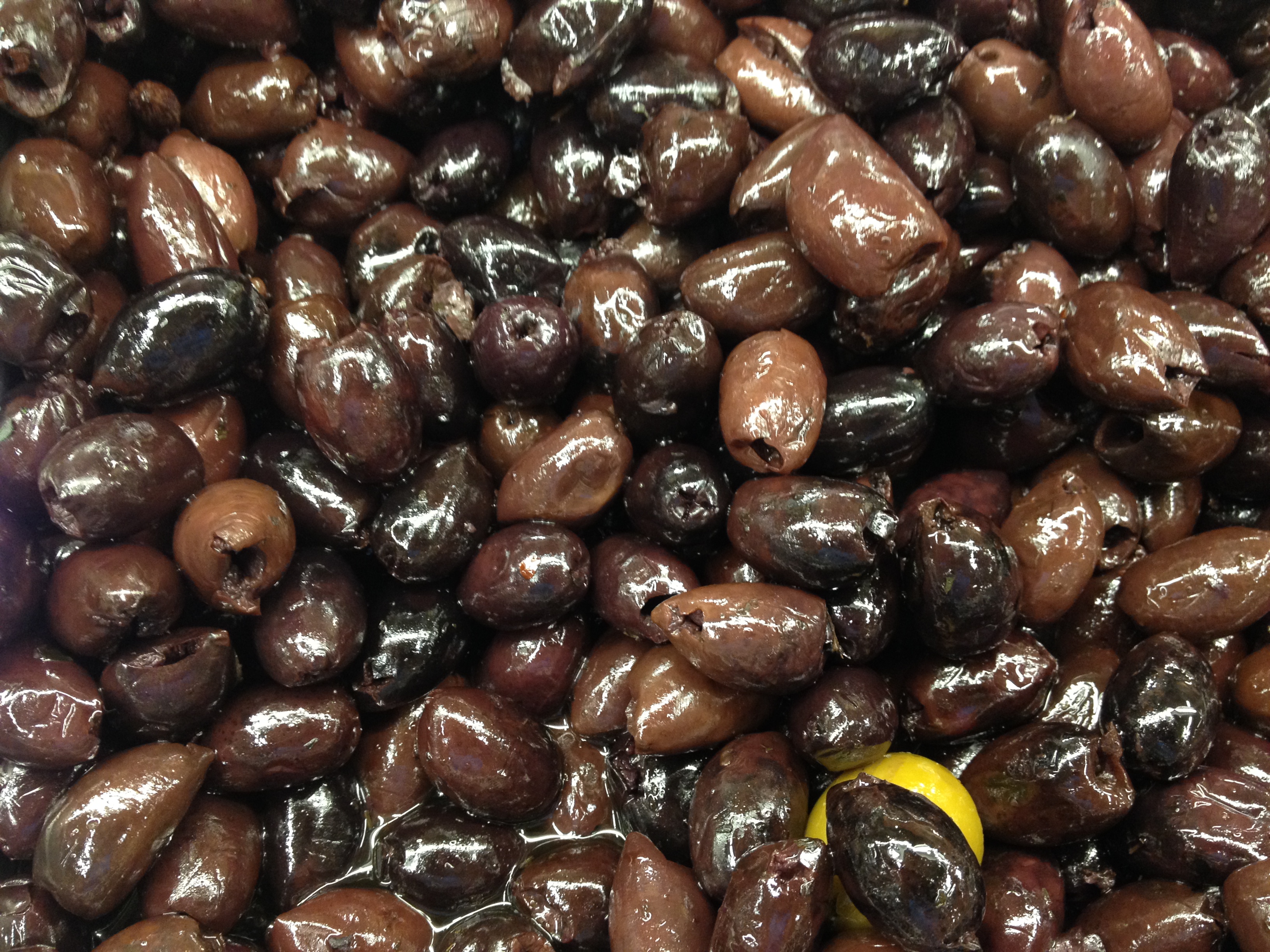
Olives have been eaten for food since ancient times. Olive trees. with their oblong, silvery leaves, have been cultivated by humans for more than 8,000 years. They are native to Syria and Asia Minor, although most of our domestic olives come from California today. The olive branch was often a symbol of abundance, glory and peace. The leafy branches of the olive tree were ritually offered to deities and powerful figures as emblems of benediction and purification, and they were used to crown the victors of friendly games and bloody wars. Olive oil has long been considered sacred. Today, it is still used in many religious ceremonies. Over the years, the olive has been the symbol of peace, wisdom, glory, fertility, power and purity. The humble olive was inspiration for the following poem:

Olives

by A. E. Stallings

Sometimes a craving comes for salt, not sweet,
For fruits that you can eat
Only if pickled in a vat of tears—
A rich and dark and indehiscent meat
Clinging tightly to the pit—on spears

Of toothpicks maybe, drowned beneath a tide
Of vodka and vermouth,
Rocking at the bottom of a wide,
Shallow, long-stemmed glass, and gentrified,
Or rustic, on a plate cracked like a tooth,

A miscellany of the humble hues
Eponymously drab—
Brown greens and purple browns, the blacks and blues
That chart the slow chromatics of a bruise—
Washed down with swigs of barrel wine that stab

The palate with pine-sharpness. They recall
The harvest and its toil,
The nets spread under silver trees that foil
The blue glass of the heavens in the fall—
Daylight packed in treasuries of oil,

Paradigmatic summers that decline
Like singular archaic nouns, the troops
Of hours in retreat. These fruits are mine—
Small bitter drupes
Full of the golden past and cured in brine.

Cultivation

Olive trees are grown not from seeds, but rather from cut roots or branches buried in the soil and allowed to root, or grafted onto other trees. The olives are the fruit of the olive tree with a single, large seed inside. Green olives are usually picked at the start of the harvest season, in September and October in the northern hemisphere. They have a firm texture and lovely, nutty flavor. Black olives are picked in November and December, sometimes as late as January, and they’re softer, richer, and meatier. Olives are full of the compound oleuropein, which give them an intense bitterness. It’s the curing process that turns that bitterness into the flavors with the sweet, salty, pungent flavor, depending on the variety, with which we are familiar.

Curing

Olive curing is a lot like fermentation—it’s the conversion of the olive’s natural sugars into lactic acid. Harsh-tasting oleuropein and phenols get leached from the fruit in one of five ways.

  • Brine-curing: Fully ripened, dark purple or black olives are gradually fermented in salt water brine which may take up to a year. Brine-cured olives are often sweet and full of depth, since the brine acts to intensify the fruit’s natural flavors.
  • Water-curing: Soaking, rinsing in plain water, and repeated many, many times is the slowest method of all, and is rarely done. The curing process occasionally begins in a water bath, and then is finished in a seasoned brine.
  • Dry-curing: These olives get packed in salt for a month or longer. The salt pulls the moisture and bitterness from the olives. The salt is then removed, and sometimes the olives get bathed in olive oil to keep them juicy and plump. Dry-cured olives have a deeply concentrated flavor, and a wrinkly, prune-like appearance.
  • Lye-curing: Large commercial olive producers use lye-curing because it is most time-conserving and cost-effective. The process, which was invented in Spain, calls for immersing raw olives in vats of alkaline lye solution. But the fast-acting lye often leaves a chemical aftertaste and a bland-flavored olive.
  • Sun/air curing: In some rare cases, olives can be fermented either on the branch or, once picked, by basking in the sunshine.

Varieties of Olives

Kalamata

The king of Greek table olives, beloved and popular Kalamatas are deep purple, with tight, snappy, shiny skin, and a pretty almond shape. They’re typically preserved in red wine vinegar, red wine, and/or olive oil for a distinctive rich, smoky, fruity flavor.

Castelvetrano

Castelvetrano olives are Italy’s most popular snack olive. Bright green, they’re often referred to as dolce (sweet), and come from Castelvetrano, Sicily, from the olive variety nocerella del belice. They have a Kermit-green hue, meaty, buttery flesh, and a mild flavor.

Cerignola

These gigantic green olives are harvested in Cerignola, in Italy’s Puglia region, the heel of the boot. They are crisp and fantastically buttery. Their hefty size makes them easy to stuff with cheese.

Nyon

These petite, jet-black olives from the south of France dry cured, then aged in brine. They are plump, wrinkly olives, a little bitter, and loaded with aromatic flavor.

Nicoise

Grown on a variety of olive tree called “Le Cailletier,” small Niçoise olives are a crucial ingredient in classic dishes of the French Riviera—like Salad Niçoise and tapenade. The Niçoise has an enticingly herbal fragrance with faint notes of licorice.

Liguria

Also called Taggiasca olives, this petite variety is grown in Liguria, in Italy’s northwestern-most region, a few miles away from France’s Niçoise olive region, and the olives are indeed similar. They’re usually cured with an aromatic mixture of bay leaves, rosemary, and thyme.

Gaeta

These small, purplish-brown, wrinkled olives from Puglia have soft, tender flesh and a tart, citrusy taste. Gaetas can be either dry-cured (shrivelly, chewy) or brine-cured (plump, juicy).

Picholine

These torpedo-shaped French green olives are wonderfully crisp and crunchy, with a tart, nutty, anise flavor.

Gordal

Gordal means “fat one” in Spanish. These are big, fat olives, with plenty of firm, meaty richness. Grown in Andalucía, Spain, where tough Gordal trees thrive in the dry climate, these are beloved tapas olives.

Alfonso

While Alfonso olives are traditionally considered Chilean, the province of Tacna, in the foothills of the La Yarada mountains, where they originated, has been under Peruvian rule since 1929. These are huge, deep purple olives that are brine-cured, then macerated in red wine. They are supple, juicy and fleshy, with a hint of sour bitterness.

Mission

Although originating in Spain, Mission olive trees have flourished in California since the 1700’s. Most of the yield goes to make olive oil, but black oil-cured and green brine-cured table olives are both mild, grassy, and bright in flavor.

Manzanilla

This familiar, friendly, oval-shaped olive from Spain is brine-cured, with a crisp texture and a slightly smoky, nutty flavor. They’re often stuffed with pimientos, or cracked and dressed with olive oil and fresh garlic.

Beldi

Morocco produces hundreds of varieties of olives, but exports only a few. They are dry-cured and wildly, intensely flavorful.

Amfissa

From the hills by Delphi, the legendary home of the ancient Greek oracles, these hand-picked olives are harvested from their branches when very ripe. They are slowly brined to coax out a mild, fruity flavor and a melt-in-your-mouth softness.


Resources

http://www.seriouseats.com

http://www.foodsubs.com

http://www.pbs.org
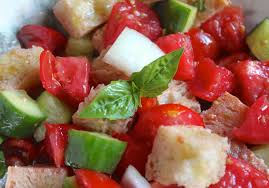
Panzanella (Tomato and Bread Salad)


Panzanella

This is a very popular country salad from the Florentine area of Italy.  It needs a firm, coarse-textured bread to be good.

Ingredients

2 c. coarse white bread, crusts removed

6 ripe tomatoes

1 red onion

1/2 cucumber

2 stalks of celery

6 sprigs of basil leaves, shredded

6 tablespoons olive oil

2 tablespoons balsamic vinegar

Salt and pepper to taste.

Directions

Cut the bread into small pieces (1/4 – 1/2 inch square)  Put the bread into a large salad bowl and sprinkle with cold water so it is well moistened but not soggy.  Add all the vegetables, cut into pieces or slices and the finely sliced basil.  Dress with oil, vinegar, salt and pepper.  Stir well and leave for 30 minutes so the bread can absorb the dressing before serving.


Week 30: Tomatoes

Tomatoes

Spring is just around the corner and it’s time to plan your vegetable garden. Naturally, no garden is complete without tomatoes.  Which varieties should you plant?  Heirloom tomatoes have by far the best flavor. Before you purchase potted tomato plants from the hardware store, consider starting your plants from organic seeds. Seed Savers, (www.seedsavers.org) dedicated to protecting endangered food crops and agricultural heritage through its seed bank  has a wide variety of organic, heirloom tomato seeds that you can order.

History

Tomatoes, originally from South America and the Galapagos Islands,  were brought back to Europe in the form of seeds by Cortez in 1519.   The Italian name for the tomato is pomodoro, meaning “apple of love” or “golden apple,” because the first to reach Europe were yellow varieties.  Initially, they were planted as ornamental plants, but were not eaten because they were thought to be poison as the plant was a member of the deadly Solanaceae, or Nightshade family. The leaves of the tomato plant, but not its fruits, do contain toxic alkaloids.

There are thousands of varieties of tomatoes in a vast array of colors, shapes and sizes. The most common shapes are round (Beefsteak and globe), pear-shaped (Roma) and the tiny cherry-sized (Cherry and Grape).  There are also a number of heirloom varieties that are not only red, but also yellow, pink, orange, green, purple, or brown in color.

The San Marzano plum tomato, an heirloom variety grown in volcanic soil on the slopes of Mt.Vesuvius near the southern Italian city of Naples, is probably the most famous tomato grown in Italy.  It was supposedly a gift from the Kingdom of Peru to the Kingdom of Naples in 1770.  Thinner and more pointed than the Roma tomatoes we see in the U.S., it has a firm pulp, a stronger tart flavor and fewer seeds. The San Marzano, Roma, Napoli and Marena varieties are mostly used for canning or bottling. The “pomodorino” (cherry tomato or vine tomato) grown mainly in the south in Sicily, Puglia and Calabria are used in salads and quick pasta sauces.

Cultivation

Tomato  plants like a warm, sunny location with well-drained soil. They typically grow to 3–10 feet in height and have a weak stem that often sprawls over the ground and vines over other plants, if not staked.  It is a perennial  in its native habitat, although often grown outdoors in temperate climates as an annual.

About 161.8 million tons of tomatoes were produced in the world in 2012. China is the largest commercial producer of tomatoes followed by India and the United States. California accounts for 90% of U.S. production of  plum or processing tomatoes and 35% of world production.

At home, companion planting  in the garden can help enhance growth, flavor and protect plants from pests. Borage, with its fresh, cucumber-like flavor, is supposed to protect tomatoes from tomato hornworms. Chives, onions, garlic and marigolds produce a smell that repels pests,

Culinary Uses

Although it is botanically a fruit, the tomato  is considered a vegetable for culinary purposes. It is eaten  raw in salads or cooked as an ingredient in a variety of dishes, sauces, and beverages. Unripe green tomatoes can also be breaded and fried, used in salsas or pickled. The high acidic property of tomatoes makes them especially easy to preserve in home canning.  The fruit is also preserved by drying, often in the sun, and sold either in bags or in jars as “sun dried tomatoes” packed in oil.

Health

Tomatoes are good sources of Lycopene, one of nature’s most powerful antioxidants.  Tomatoes are an excellent source of vitamin C, vitamin A, and vitamin K, Vitamin E and numerous other vitamins and minerals.

Buying and Storing

When you select tomatoes for purchase, smell the blossom (not stem) end. The most flavorful ones will have a rich tomato aroma. If they are not yet ripe, keep them in a sunny window sill until they are ready to eat. Remember, too, that it is best not to refrigerate tomatoes or their texture becomes mushy and the flavor diminishes.

Resources

http://www.treehugger.com

http://www.food.com

http://www.whfoods.com

Week 29: Edible Flowers

Edible flowers2

Winter in New England has been long and cold this year, but warmer weather is just around the corner.  Nothing heralds spring so much as tender young blossoms emerging from the soil!  Many of these flowers are edible and add color, flavor, aroma and elegance to entrees, salads and desserts.  I recently ordered an Edible Flower Garden kit from http://www.bambeco.com and can hardly wait for it to arrive!

The concept of using flowers in cookery is not new. Cooking with flowers dates to Roman times, and to the cuisine of China, India, and the Middle East. The Victorians, who associated edible flowers with elegance, candied violets to decorate cakes and desserts. Italian and Hispanic cultures gave us stuffed zucchini blossoms. Chartreuse, a classic green liqueur developed in France in the 17th century, uses carnation petals as one of its secret ingredients.

It was common to dry the petals and include them in tea blends. Popular tea flowers were hibiscus, rose, jasmine and bee balm. Bee balm was used as a tea substitute when black tea became unavailable during the Boston Tea Party in 1773. To preserve violets, medieval monks made a sweet syrup from the petals.

The most common flowers used in cooking are:

Alliums (leeks, chives, garlic, garlic chives) – Known as “onion flowers,” they include the blossoms from onions, garlic, chives, ramps, and shallots. Their flavors range from mild onions and leeks right through to strong onion and garlic. All parts of the plants are edible.

Anise Hyssop (Agastache foeniculum) – Both flowers and leaves have a delicate anise or licorice flavor, which remind some people of root beer. The blossoms are excellent in salads and make attractive plate garnishes and are often used in Chinese cuisine.

Basil (Ocimum basilicum) – Blossoms are bright white, pale pink, or a delicate lavender. The flavor of the flower is milder, but similar to basil leaves.  Some varieties have different milder flavors like lemon and mint.

Bee Balm (Monarda didyma) – Also called Wild Bergamot, Wild Oswego Tea, or Horsemint, wild bee balm tastes like oregano, mint or citrus like lemon and orange. It is the main ingredient in Earl Gray Tea.

Begonias (Begonia X tuberosa) – Tuberous begonia petals are used in salads and as a garnish with have a citrus-sour taste. Stems, also, can be used in place of rhubarb. The flowers and stems contain oxalic acid and should not be consumed by individuals suffering from gout, kidney stones, or rheumatism.

Calendula (Calendula officinalis) – Also known as marigolds, the calendula had golden-range hued petals and flavors that range from spicy to bitter, tangy to peppery. Only the petals are edible and add a yellow tint to soups, spreads, and scrambled eggs. Sprinkle them on soups, pasta or rice dishes, herb butters, and salads. The sharp taste resembles saffron (also known as Poor Man’s Saffron).

Chrysanthemums (Chrysanthemum coronarium) – Tangy, slightly bitter, ranging in colors from red, white, yellow and orange, chrysanthemum petals range in taste from faint peppery to mild cauliflower. Blanche the petals first and then scatter them on a salad. Always remove the bitter flower base. Young leaves and stems of the Crown Daisy, also known as Chop Suey Greens or Shingiku in Japan, are widely used in oriental stir-fries and as salad seasoning.

Cilantro/Coriander (Coriander sativum) – Like the leaves and seeds, the flowers have a strong herbal flavor. Use leaves and flowers raw as the flavor fades quickly when cooked. Sprinkle to taste on salads, bean dishes, and cold vegetable dishes.

Dandelions (Taraxacum officinalis) Dandelions are members of the daisy family. Flowers are sweetest when picked young. They have a sweet, honey-like flavor. Mature flowers are bitter. Young leaves taste good steamed, or tossed in salads. When serving a rice dish use dandelion petals like confetti over the rice.

Fennel (Foeniculum vulgare) – Fennel has spiky yellow flowers that have a mild anise flavor. Use with desserts or cold soups, or as a garnish with your entrees.

Ginger (Zingiber officinale) – Petals from the white variety of ginger is very fragrant and has a gingery taste on the tongue. They may be eaten raw or the tender, young shoots can be cooked.

Impatiens (Impatiens wallerana) – Impatiens, which have a sweet flavor, can be used as a garnish in salads or floated in drinks.

Lavender (Lavandula angustifolia) – Lavender flowers look beautiful and have a sweet, floral flavor, with lemon and citrus notes. They can be added to a glass of champagne, served with chocolate cake, or used as a garnish for ice creams. Lavender lends itself to savory dishes also, from hearty stews to wine-reduced sauces. Diminutive blooms add a mysterious scent to custards, flans or sorbets. NOTE:  Do not purchase and consume lavender oil, as it may be poisonous.

Lemon Verbena (Aloysia triphylla) -\Lemon verbena sports diminutive cream-colored citrus-scented blossoms. Leaves and flowers can be steeped as an herbal tea, and used to flavor custards and flans.

Mint (Mentha spp) – The flavor of mint flowers are, as their name implies “minty,” but with different overtones depending variety. Mint flowers and leaves are great in Middle Eastern dishes.

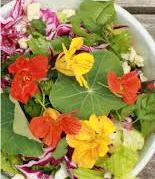
Nasturtiums Tropaeolum majus) – Nasturtiums are my favorite edible flowers.  They come in brilliant sunset colors with peppery flavors. Blossoms have a sweet, spicy flavor similar to watercress. Stuff whole flowers with savory mousse. Leaves add peppery tang to salads. Pickled seed pods are less expensive substitute for capers. Use the entire flower to garnish platters, salads, open-faced sandwiches, and savory appetizers.

Pansy (Viola X wittrockiana) – Pansies have a slightly sweet green or grassy flavor. If you eat only the petals, the flavor is extremely mild, but if you eat the whole flower, there is a winter, green overtone. Use them as garnishes, in fruit salads, green salad, desserts or in soups.

Violets (Viola species) – Sweet, perfumed flavor. Related flowers, Johnny jump-ups or violas, and pansies now come in colorful purples and yellows to apricot and pastel hues. They are great in salads or as a garnish for desserts. They can also be crystallized. The heart-shaped leaves are edible, and tasty when cooked like spinach.

NOTE:  Do not use herbicides and pesticides on plants whose blossoms you want to use in the kitchen, and NEVER collect flowers from along the roadside or from the florist.  Not all flowers are edible and could make you sick if you digest the wrong ones. Remove pistils and stamens before using.  Only the blossom petals should be consumed.

Resources

homecooking.about.com

http://www.gardenguides.com

http://www.whatscookingamerica.net

http://www.wikipedia.org


Perfect Eggs

Here are some tried and true methods for egg preparation.

scrambled eggs

Scrambled

Use 2 eggs and one egg yolk per person. Whisk until well blended and add a small amount of heavy cream.  Melt butter over medium low heat in a skillet.  When butter begins to foam, add eggs.  Using a wooden spatula, gently scrape eggs from bottom of pan until eggs begin to set. Cover pan and reduce heat to low for 1-2 minutes. If you want to add diced onion, mushrooms or green peppers to your scrambled eggs, sauté the vegetables in a separate skillet until onions are translucent and mushrooms and green peppers are tender. Add vegetables to egg and cream mixture before you transfer it to the saucepan for cooking.

Boiled

Place eggs in a saucepan and cover with water.  Bring to boil over high heat.  Once water begins to boil, time eggs for 8 minutes.  Remove from heat and drain off hot water.  Fill saucepan with cold water and allow eggs to cool.  Crack eggs under water for easy peeling.  Older eggs will peel easier than fresh ones.

Fried

A perfectly fried egg should not have crusty edges nor a browned bottom. Using a well-seasoned cast iron griddle or a nonstick skillet, melt butter over medium low heat until it begins to foam. Break eggs into skillet. Cook until white turns opaque. For over easy, turn with spatula and continue cooking for about 30 seconds or until egg white covering the yolk has turned opaque.  For over medium, cook slightly longer so yolk has begun to set.

Poached

Fresh eggs work better for poaching.  Crack and egg into a small dish.  Meanwhile, fill a skillet half full with water and bring to boil.  Reduce heat to medium low to keep water simmering.  Add 1/2 t. salt and 2 T. white vinegar to water.  Using a whisk, stir water in a circle until a vortex or depression forms in the center.  Carefully, pour egg from bowl into the vortex. Cook for 4 -5 minutes.  Remove with slotted spoon.  The salt and vinegar helps keep the egg white compact. Serve on toast, English muffins or fried corned beef hash.


Week 28: Eggs

Eggs

Eggs have been eaten by humans for thousands of years.  They can be cooked in a variety of ways and are commonly eaten for breakfast, are healthy additions to soups, salads, sandwiches, entrees, and are essential for baking.

Eggs are laid by females of many different species, including birds, amphibians, reptiles and fish. The most commonly consumed egg is from the chicken, although duck, goose and quail eggs are prominent as well. The largest bird eggs, from ostriches tend to be used only as special luxury food. Gull eggs are considered a delicacy in England and Norway and guinea fowl eggs are commonly seen in African marketplaces. Although pheasant and emu eggs are just as edible, they are not as widely available. Most laying hens in the U.S. are Single-Comb White Leghorns.

History

There is evidence of eggs eaten in Southeast Asia and India as far back as 7500 BCE and Egyptian and Chinese records show domesticated birds producing eggs for human consumption as in 1400 BC. In ancient Rome, meals often began with a preserved egg course. During the Middle Ages, eggs were forbidden during lent because of their richness. The word mayonnaise may have been derived from moyeu, the medieval French word for the yolk, meaning center or hub.

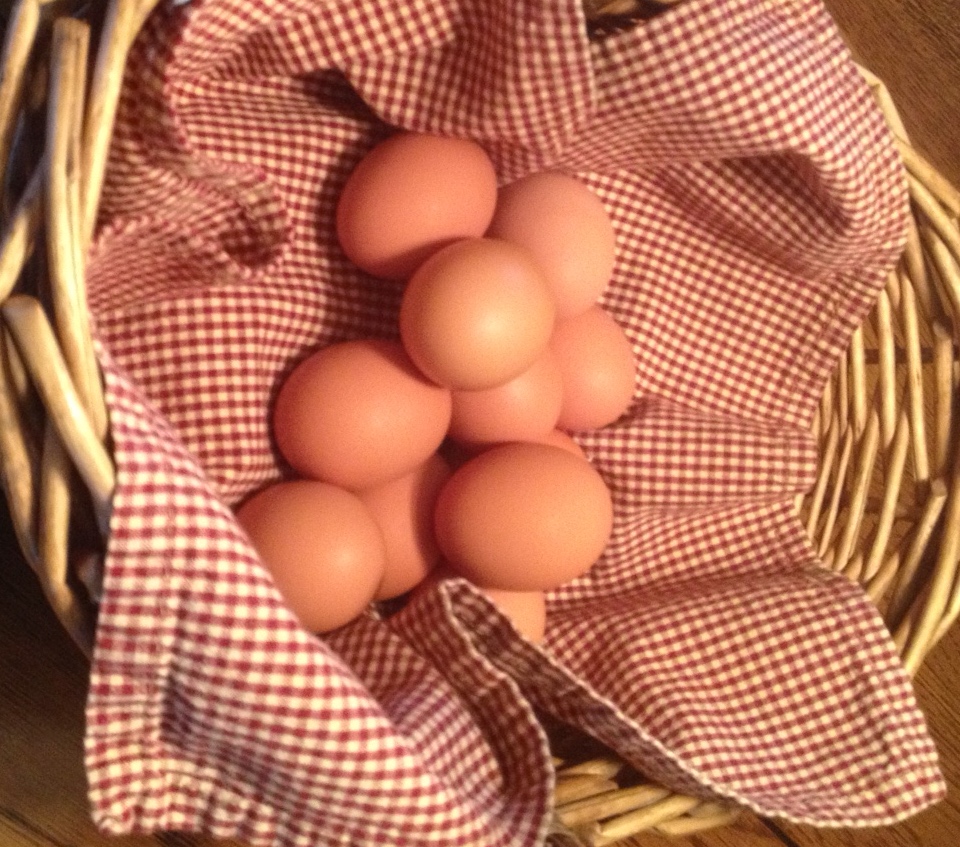
Before the invention of the egg carton, eggs were gathered and carried in egg baskets. A predecessor to the modern egg box was invented by Thomas Peter Bethell of Liverpool in 1906 and marketed as the Raylite Egg Box. He created frames of interlocking strips of cardboard. These frames were themselves packed in cardboard or wooden boxes for transport by road or rail. In 1911, the egg carton was invented by Joseph Coyle in British Columbia to solve a dispute about broken eggs between a farmer and the owner of a hotel that he supplied. Early egg cartons were made of paper.

Grading

Eggs are composed of the shell, albumin or white, and the yolk.  An egg is a prolate spheroid, with one end larger than the other. The air cell is on the larger end of the egg and its size is used in grading the eggs. A very fresh egg has a small air cell and receives a grade of AA. Its “spread” is compact, the albumen is clear, thick and firm, the yolk stands round and high. Grade A eggs have a slight spread, clear and reasonably firm albumen and a yolk that stands fairly high and practically free from defects.  A grade B egg spreads over a wide area, has a clear, weak or watery albumen and an flattened yolk. As an egg gets older, the larger end of the egg will rise to increasingly shallower depths when the egg is placed in a bowl of water. A very old egg will actually float in the water and should not be eaten. Eggs come in sizes of jumbo, extra large, large, medium, small and peewee.

Health

Eggs contain significant amounts of protein, vitamins, antioxidants and are about 70 calories each.   More than half the calories found in eggs come from the fat in the yolk. Thus, people on a low-cholesterol diet may need to reduce egg consumption. The egg white, however, consists primarily of water (87%) and protein (13%) and contains no cholesterol and little, if any, fat. Despite their nutritional value, however, there are health concerns involving allergy, storage and preparation. To prevent salmonella poisoning, always cook eggs thoroughly.

Culinary Uses

An egg can be boiled, scrambled, fried, poached, made into an omelet or pickled. It is used as an emulsifier (help suspend one liquid in another, as in salad dressings) and as a thickener. The proteins in egg white allow it to form foams and aerated dishes. Egg whites, which contain the protein and very little fat,  may be aerated or whipped to a light, fluffy consistency, and are often used in desserts such as meringues and mousse. Eggs can also be soaked in mixtures to absorb flavor. Tea eggs are steeped in a brew from a mixture of various spices, soy sauce, and black tea leaves to give flavor.

Pidan (also known as hundred year or thousand year eggs) is a Chinese method of preserving duck, chicken or quail eggs in a mixture of clay, ash, salt, lime and rice hulls for several weeks to several months. In the process, the yolk becomes dark green to gray in color and develops a creamy consistency with an odor of sulphur and ammonia.  The egg white becomes a dark brown, translucent jelly with a salty flavor. Century eggs are often eaten without further preparation, on their own or are used as a side dish, sometimes with ginger root or tofu.

A Balut is a developing duck embryo (fertilized duck egg) that is boiled and eaten in the shell. It is commonly sold in the Philippines, Laos, Cambodia and Vietnam. The broth surrounding the embryo is first sipped and then the undeveloped chick inside is eaten, often with salt and/or a chili, garlic and vinegar (white or coconut sap) mixture as seasoning.

Storage

Uncooked eggs can be kept refrigerated for up to 4-5 weeks, while hard-boiled eggs left in their shells should be used within a week.

Commercial Production vs. Cage Free

Commercial factory farm operations often involve raising the hens in small, crowded cages, preventing the chickens from engaging in natural behaviors, such as wing-flapping, dust-bathing, scratching, pecking, perching and nest-building. Many hens have their beaks removed to prevent harming each other and to prevent cannibalism. In the United States, increased public concern for animal welfare has resulted in the United Egg Producers program which includes guidelines regarding housing, food, water, air, living space, beak trimming, molting, handling, and transportation. However, some organizations such as the Humane Society, claim that the UEP certification is misleading. “Certified Organic” labeling, which requires hens to have outdoor access and be fed only organic vegetarian feed and so on, is considered the most humane.

Cultural Traditions

During Easter in many countries, eggs are dyed, decorated and hidden for children to find. Before the spring equinox in the Persian New Year tradition, each family member decorates a hard-boiled egg and sets them together in a bowl. The tradition of a dancing egg is held during the feast  Corpus Christi in Barcelona and other Catalan cities since the 16th century, which consists of an emptied egg, positioned over the water jet from a fountain, which starts turning without falling.

Resources

Labensky, Sarah R., and Alan M. Hause. On Cooking: A Textbook of Culinary Fundamentals.

Wikipedia

http://www.eggnutritioncenter.org

http://www.incredibleegg.org

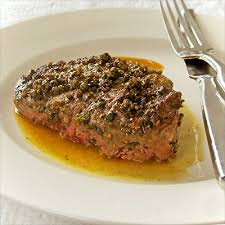
Steak au Poivre

Steak au Poivre

Ingredients:

2 T. peppercorns, coarsely crushed

4 New York strip steaks

2 T. butter

2 T. olive oil

2 T. brandy

¼ c. beef stock

½ t. Dijon mustard

¼ t. Worcestershire sauce

Salt

Directions:

Sprinkle both sides of steak with crushed peppercorns. Press into steaks using fingers.  Add the butter and olive oil to a skillet and brown the steaks on both sides.  Steaks will be rare.  Cook longer if you want them more done. Transfer to hot serving platter.  To the juices in skillet, add remaining ingredients and simmer until thick.  Serve over the steaks.