Category Archives: My Stories

Pizza

My day in the kitchen was beginning to follow a routine.  When I first arrived at the hotel, I changed into my uniform and then got a cup of espresso from Domenico.  He was the barista for the restaurant.  Then I donned a fresh apron and started working.

In the mornings we did a lot of prep work.  At first I thought they were giving me all the tomatoes to dice, carrots and potatoes to peel and zucchini to shred with the mandoline because I was the intern or apprentice (or maybe a woman?).  But I looked around and noticed that everyone was dicing and slicing ingredients for the day’s recipes.  Chef posted the daily specials on the bulletin board along with that day’s employee menu.  We washed lettuce, separated basil, made tomato sauce, cleaned fish and grated Parmigiano cheese each morning.

After the employee lunch, I changed into a clean apron and followed the other chefs through the main dining room and hotel lobby to the elevator etched into the rocky hillside at the back of the hotel.  We traveled down several levels to the restaurant. The restaurant by the pool is open air with views of theMediterranean. Tables are set with white table cloths and flowers. Hanging baskets adorn the thatched roof. They serve about 50-60 people during lunch service and guests dine in pool attire. White jacketed waiters (no waitresses) took the orders and brought them to an open counter that separated the smaller kitchen from the open air dining room. They read out the orders in Italian and then place the order slip under a paperweight on the counter.  One chef manned the brick pizza oven and grill, another handled all the cold salads and appetizer plates, one assembled the desserts and Alessandro was in charge of preparing the pasta and main dish.

“Let me show you how to make an Italian pizza.”  Alessandro said as lunch service ended. He led me over to the alcove in the dining room where the brick oven was located.

“This is our pizza oven.  It is made of brick and is fired by wood.  It is supposed to keep an even temperature, but it has a crack in it and cooks unevenly.”  He opened a refrigerated, stainless steel drawer beneath the oven and extracted a round ball of pizza dough.  Alessandro flattened it with his hands and carefully rolled it out with a marble rolling pin.

“I thought you were supposed to toss it in the air,” I said.

He smiled, “That is only in the movies.”  He spread sliced tomatoes on the flattened round of dough and adorned it with fresh mozzarella cheese.  Alessandro scooped it up with a flat, wooden paddle and inserted it into the oven near the hot coals.  We watched the cheese melt and he turned it slightly to keep the crust from burning.  Then he removed it with the wooden paddle and placed it on the counter.  Alessandro sliced the pizza with a sharp knife and handed me a piece.

“This is Pizza Margherita,” he said. It was delicious!

When I returned to Positano, I always went down to the internet cafe to check my email.  Brandi was using the computers at the internet café when I got there after work.  We talked for a few minutes and she told me what her kids were doing. I purchased a bottle of water and found a stool in front of a computer.

Craig emailed that he had been spending a lot of time working on our lawn and clearing a path down the hillside behind our property to the beach. He sounded resentful that I wasn’t there to help and seemed to indicate that he was working hard while I was having fun. Although I felt a little guilty about not being there helping, I decided not to address his complaints. Instead, I complimented him on all the work he was doing. I told him what I’d been doing in the kitchen and thanked him again for encouraging me to become a chef.

After answering emails, I headed back up the stone steps that would take be to the apartment. I found our neighbor Paulo watering the vegetables and flowers in his garden.  Paulo was in his mid-70s – short and wiry, his skin was like tanned leather and he always had a smile on his face. He was the one who had planted basil in lieu of grass in our front yard, and he regularly harvested the huge lemons from the trees that shaded the laundry on our clotheslines.
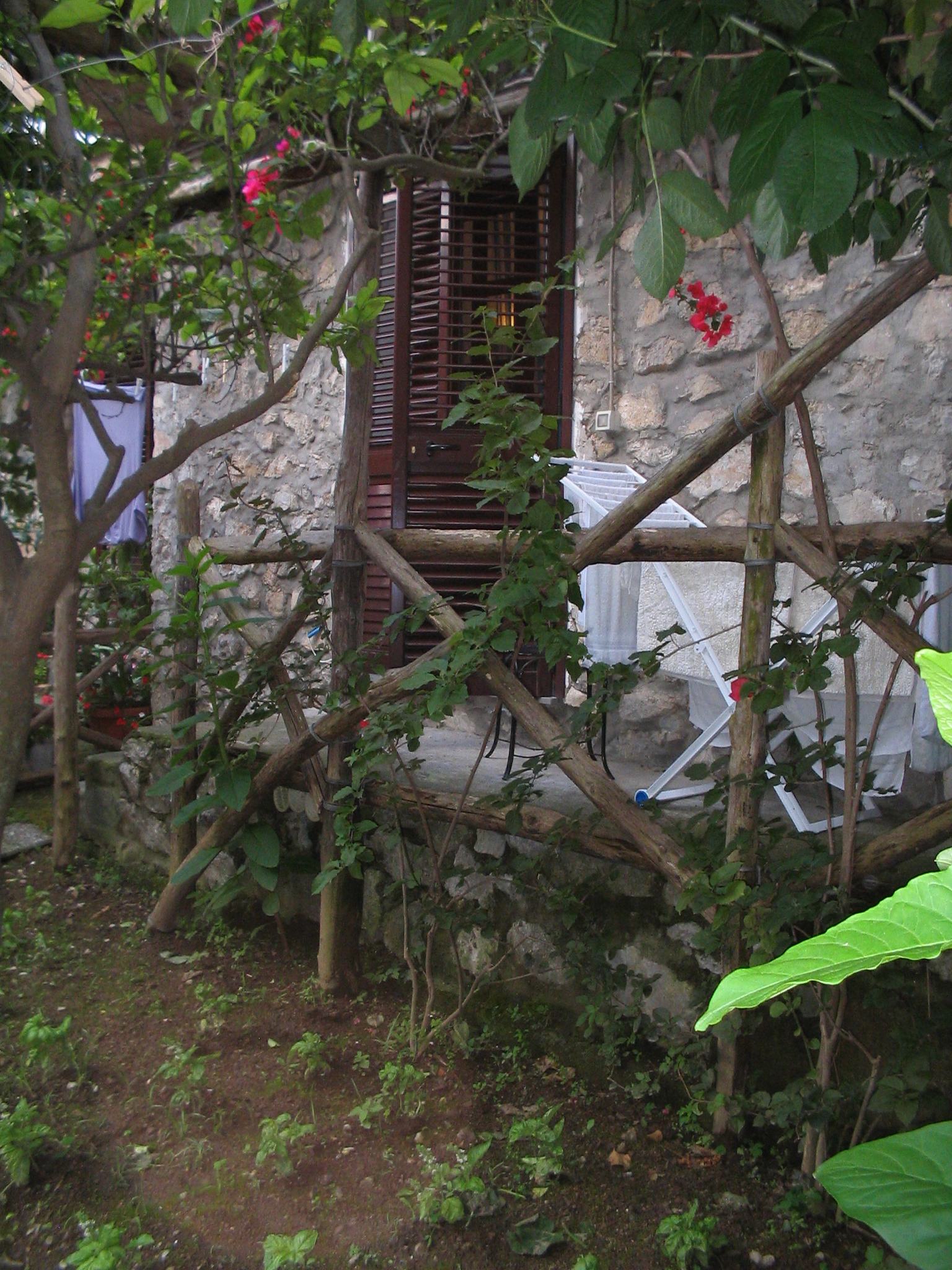
Basil & lemons in our front yard


            “Buona sera. Good afternoon,” he greeted me.


Buona sera,” I replied.  “Come sta oggi? How are you today?”


Molto bene. Very well. I have been making limoncello.” He turned off his hose and asked, “Have you tried it? Let me pour you a glass of my homemade recipe,” he offered as he invited me into his apartment. Paulo told me his recipe started with grain alcohol as he poured me a tiny little glass of the chilled liquid. Whoa!  It was like fire going down and made my eyes water.


“Oh,” I choked. “That tastes nice and lemony.” It was not as smooth as the limoncello we had purchased for the apartment, and it was the nicest thing I could think of to say.
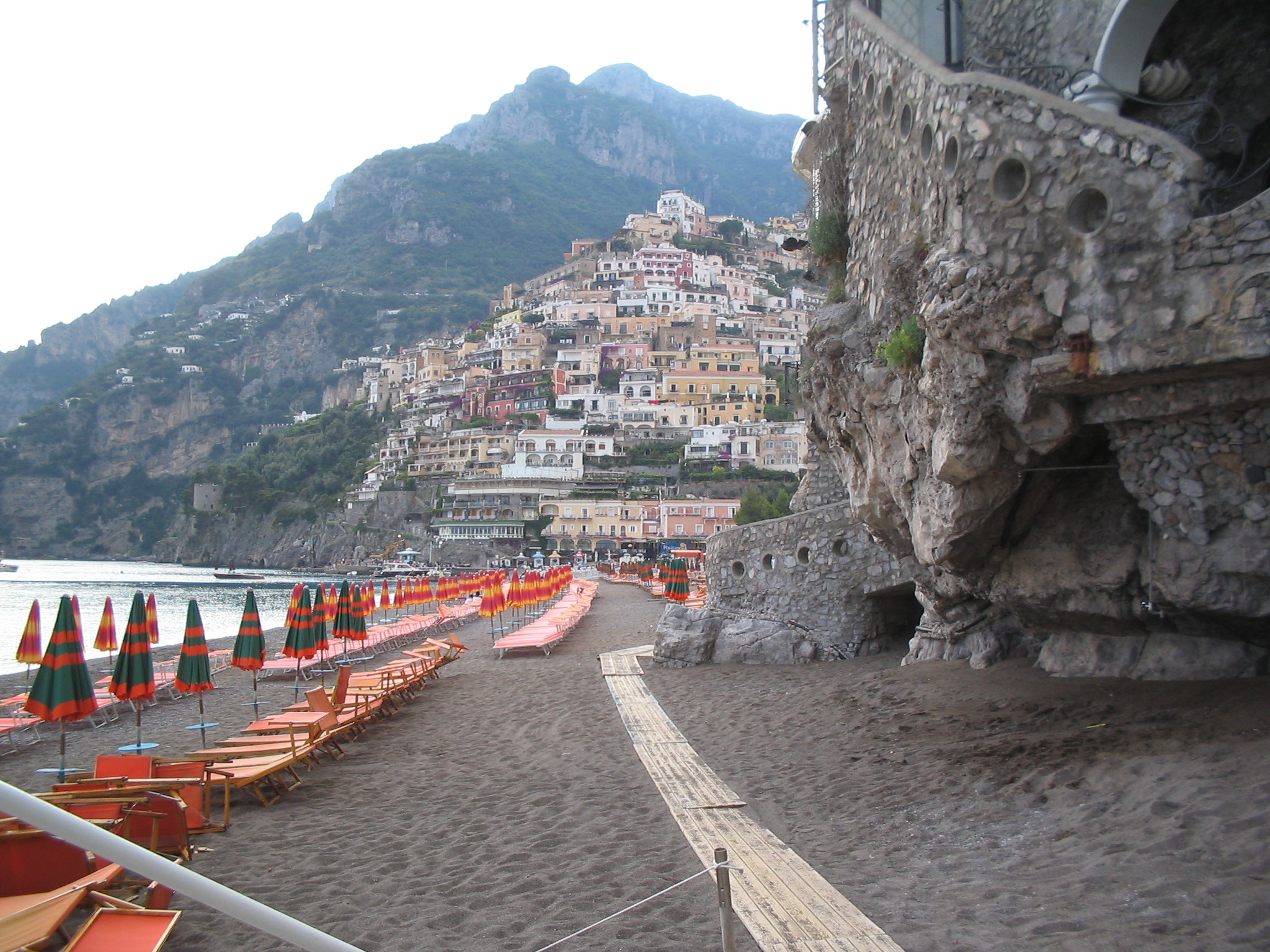
Positano

Positano is…

Pastel-colored stucco buildings, weathered by the sun and wind, spilling down steep hillsides that plunge to the turquoise sea;

Purple Bougainville-draped arbors, lemon trees laden with aromatic fruit and gray-green olive trees clinging to the terraced slopes;

Laundry dancing on balcony railings and clotheslines strung from window to window above the narrow cobblestone alleyways.

A rooster crows “koo-kee-eye-oh” that sounds like the word cucchiaio which means “spoon” in Italian;

A stray cat softly mewing as it stretches itself in the morning sun;

The whoosh of cappuccino machines and the aroma of fresh-baked pastries wafting out open windows;

Melodic church bells calling the devout to mass.

A gray sand beach speckled with towels and beach chairs you can rent by the day;

Blue and yellow row boats lined up on the beach waiting to be inspected by fishermen;

Old men playing the card game Scopa on the sidewalk outside the internet café;

Artists at their easels capturing the town in vibrant colors on canvas.

Shop keepers standing in doorways smoking cigarettes;

Tourists strolling by with cones of gelato inspecting brightly-colored beach towels and t-shirts, Hand-painted ceramic bowls, and Rows of handmade leather sandals bedecked in jewels.

The whine of motor scooters and the screech of bus brakes as they maneuver the tight turns along the cliffs above the village;

The smell of garlic and olive oil wafting on a balmy breeze;

Cafes with tables on the sidewalk;

Shouts from a bar when Italy’s team scores a soccer goal and occasional fireworks that celebrate a victory.

 …where I lived one summer

Pomodore Galore

Cooking in Southern Italy, where we were located, is characterized by lots of tomato dishes, made with the freshest pomodore (tomatoes) possible.  The Italian name for the tomato means “apple of love” or “golden apple,” because the first to reach Europe were yellow varieties.  Initially, they were planted as ornamental plants, but were not eaten because they were thought to be poison. However the innovative (and probably starving) peasants of Naples started using the supposedly deadly fruit in many of their foods, including their early pizzas.

Tomatoes have healthy properties that are now recognized throughout the world.  They are good sources of Lycopene, one of nature’s most powerful antioxidants. Tomatoes are an excellent source of vitamin C, vitamin A, and vitamin K, Vitamin E and numerous other vitamins and minerals.

The Italians consume approximately 50kg (110lb) of tomatoes per head per year, most of this in the form of sauces and purees. There are thousands of varieties of tomatoes in an array of shapes, colors and sizes . The most common shapes are round (Beefsteak and globe), pear-shaped (Roma) and the tiny cherry-sized (Cherry and Grape).  Tomatoes can be red, yellow, pink, orange, green, purple, or brown in color. The San Marzano plum tomato, an heirloom variety grown in volcanic soil on the slopes of Mt.Vesuvius near the southern Italian city of Naples, is probably the most famous tomato grown in Italy.  It was supposedly a gift from the Kingdom of Peru to the Kingdom of Naples in 1770.

When you select tomatoes for purchase, smell the blossom (not stem) end. The most flavorful ones will have a rich tomato aroma. If they are not yet ripe, keep them in a sunny window sill until they are ready to eat. Remember, too, that it is best not to refrigerate tomatoes or their texture becomes mushy and the flavor fades.

I spent the morning dicing and chopping different kinds of tomatoes for the recipes that we were making that day. I started with plump ripe tomatoes for use in making cream of tomato soup.  Back at school, we would have peeled and seeded the tomatoes first, but they didn’t bother with that here.  As I diced the tomatoes, I found myself still wondering if I was destined to be a Chef or if the future had something else in store for me.

I picked another tomato out of the wooden crate and placed it on the cutting board.  I had always believed that God gives us certain talents and then provides opportunities for us to develop them, although we make the choices.  Maybe I should evaluate my strengths and weaknesses?  Would that provide a clue? Let’s see… I am tidy, well organized, patient, and am good at nurturing.  In fact, some times I try to do too much for my husband and children.  Creating recipes that bring pleasure to others certainly utilized all my talents and I thoroughly enjoyed all that I was learning, so maybe I was on the right track.

After the employee lunch of sliced pork roast, steamed zucchini and macaroni and cheese,  I changed into a fresh apron and followed Alessandro down the steps to the restaurant by the pool to help with lunch service.

           The special of the day was a sautéed sea bass, garnished with some of the tomatoes that I had chopped in the morning.

“You know how to make Caesar salad?” asked Alessandro as he gently shook the sauté pan containing the sea bass back and forth. “You teach me?” This surprised me.  Wasn’t Caesar Roman?  Surely every Italian chef knew how to make Caesar salad.

“Yes, I make Caesar salad.  I write it down for you.” I pulled out the little tablet that I kept in the pocket of my chef’s pants and, mulling over the proper Italian terms, I wrote the recipe down for Alessandro.  Maybe Eric was right – I could teach them something.

            Later that afternoon when I returned to Positano, I headed down to the beach. I had heard that there were shards of pottery washed smooth by the sea lying along the beach much as we find beach glass in the states.  I wanted to collect some of it and maybe make a necklace or bracelet when I returned home. I had forgotten that there was a music festival taking place in Positano this week.  A huge wooden platform was set up on the beach as the stage for a series of performers that begin serenading the tourists at dusk with music that varied from jazz to classical.

            I removed my sandals and walked in the cool sand looking for “beach pottery,” as the words of an Italian love song filled the air.  It reminded me of the Andrea Bocelli CD “Romanza” that I listen to at home, and made me think of Craig. I had been away from home only a few weeks, but it seemed like much longer. As I bent down to retrieve a piece of blue and white pottery the size of a quarter, my cell phone rang.

“Hello.”

“Hi, Mom.  It’s Gretchen.  What are you doing?”

“Gretchen!  What a nice surprise!  I was just collecting bits of pottery on the beach to bring back home.  I thought maybe I could figure out how to make some jewelry out of it. What are you doing?”

“I can’t promise anything for sure, but I was thinking of coming to visit you.  I have a trip coming up to Rwanda and since I have to change planes in Europe, I thought I might be able to stop in Rome and come down and see you for a couple of days.”  Gretchen and her husband, Andrew, had spent their honeymoon in Positano so she was familiar with where I was working.

“That sounds like a great idea,” I responded.  “We have a sofa that you can sleep on.” I reminded myself to make sure that Ben wasn’t going to be using it. Gretchen was very eager to hear about everything that was going on in the kitchen.  We spoke for several minutes before she had to go.  I hoped she would be able to make it to Italy.

The Walk-In

Mornings in the kitchen are very busy.  In addition to doing prep work for the day’s menu, there are deliveries of fresh produce, meats and seafood to receive—lettuce, escarole, zucchini, eggplant, tomatoes, pumpkin, onions, and carrots.  Italian cuisine relies on the freshest ingredients. Alessandro said that Chef wanted us to help clean out the walk-in refrigerator where the produce was stored to make room for that morning’s delivery.  We were to throw away all the old vegetables, wipe down the shelves, sweep and mop the floors.

The walk-in refrigerator at Santa Caterina is like a refrigerated closet about half the size of a single-car garage. It was kept at a temperature of 38 degrees F.  Alessandro and I carried the plastic crates of vegetables out of the walk-in and placed them on the marble table where the Garde Manger chef usually worked.  We sorted through everything and began reshelving the crates.  He handed me a large container of eggplant and opened the door to the refrigerator for me so I could enter.  My face was hit by a blast of cool air and I smelled the earthy fragrance of the vegetables in the locker as I stepped inside. “Clunk” the refrigerator latched behind me.  The light was still on and I was able to see where to place the crate of eggplant on one of the shelves.  Then I turned around and fully realized that the door had locked behind me. There wasn’t a handle on the inside that I could use to open the door.  The walk-in refrigerator at HCAT back in the U.S. had a handle on the inside.  What was I going to do now?  Hmmm. Well, I certainly wouldn’t go hungry.  There was a lot of food in here. But I was wondering how to calculate the amount of air inside.  Craig would know how to figure it out. How long would I last? Would someone notice I was missing?  Then I had an idea. I timidly stepped towards the door and knocked.  A few seconds passed and the door opened. Alessandro stood there shaking his head.  He raised his arms, palms up and said,

Che cosa sono io che vado fare con voi?” (What am I going to do with you?)

I gave him a sheepish grin and went to get the mop.

Chef had been carving watermelons with floral designs to decorate the tables in the main restaurant While we were cleaning out the refrigerators. He finished the one he was working on and beckoned for me to come over. He showed me how he carved designs in them.

The afternoon was spent prepping things for dinner service.  I was exhausted by the end of the day. Dark clouds promised rain as I left the hotel.  There were more tourists than usual hovering around the bus stop in Amalfi waiting to see which buses would take them to their destinations.  I realized that the ferries were not running due to the weather and the bus would be crowded.  If you are not one of the first people to board the bus, you chance having to stand up which is always challenging given the twists and turns of the roads. I decided that it would be a good time to browse through the bookstore and board a later bus to Positano.  I also wanted to purchase a scale so I could see if I had lost any weight.  Walking up and down these steep hills must be making a difference.  When I had first arrived in Positano, I had weighed myself on the scale in front of the pharmacy in town and the result was alarming.  But it had been broken ever since with a sign taped to it that said “Non funzionando,” or not working.  I wanted to know if my weight loss was progressing. I found a couple of interesting novels at the book store and then wandered through the piazza and up the cobblestone walkway to search for a hardware store.  Luckily, there was a small appliance store that had an assortment of scales and I purchased one.

When I returned to the bus stop, the bus to Positano had just arrived and I climbed on board and scanned the available seats for one next to the window.  As I started to sit down, I noticed a big wad of chewing gum on the cloth seat and decided to move across the aisle to another seat.  Some English tourists boarded the bus behind me and the woman plopped down on the seat that I had rejected.

“Oh,” she cried out a moment later. “There’s gum on me bum!”

Her husband scrutinized her wide bottom and produced a white handkerchief that he used ineffectively to wipe the gum from her skirt.  They were both still muttering over her plight when the bus reached Positano and I got out.

I arrived at the apartment earlier than usual that afternoon and found Brandi talking on the telephone to her children at home, David sleeping and Ben reading in the living room.  They were all taking their afternoon break and had to return to work at 6 PM. I knew that Brandi really missed her two children, who were living with her Mom for the summer while she was in Italy.  David had a girlfriend at home and talked to her and his parents often in the late evening after work. He was generally very quiet and was very focused on his work at Le Sirenuse. He kept a small, digital camera in the pocket of his chef’s pants and would show us all photos of some of the food that he had helped prepare. When he wasn’t working, he spent a lot of his free time trying to catch up on his sleep.  Ben was an avid reader and was engrossed in The Hitchhiker’s Guide to the Galaxy. Sometimes he would read right up until the time he was supposed to start his afternoon shift and would dart out the door running to get there in time. I think that was why he often left the apartment a mess.  I decided that this would be a good time to talk with him about keeping things clean.

“Ben?”

“Yes, Mama,” he replied. (Was he mocking me?  Making fun of my age?)

“Ben, I don’t care what your bedroom looks like, but we all need to use the main rooms and you’ve got to keep your junk picked up.”

“Yes, Mama. I understand.  I’ll clean up from now on.”  He got up off the couch, put down his book and carried his dirty dishes into the kitchen. It annoyed me that he had called me “Mama.”  I was here to learn about Italian cooking – not to be his babysitter!

Lemons

           The Amalfi Coast is famous for their lemons, which are huge—often 6-8 inches in length.  The lemon trees planted along the Amalfi Coast are grown on well-drained terraced land overlooking the Tyrrhenian Sea, where they get the required six hours of sunlight daily. The variety that is grown is called Sfusato Amalfitano, from the Italian word affusolato which means streamlined and refers to the lemon’s elongated shape. It has a thick, pale yellow skin with an intense aroma that comes from the essential oils in the skin.  The pulp is acidic and juicy with very few seeds.         

           The existence of lemon groves are documented as early as the 11th century when crusaders, returning from Palestine, brought along citrus fruit trees.  In the 15th century the beneficial effects of vitamin C against scurvy was discovered. Matteo Camera, a historian from Amalfi, wrote in the 17th century that lemons were shipped from Minori, a picturesque fishing village located between Positano and Amalfi, two hundred years earlier.  He also documents that shipments included limoncello and cetrangoli (bitter oranges).

            The harvest of Amalfi Coast lemons is limited to 25 tons per hectare.  The lemons are picked by hand from February to mid-October.  Nets are placed under the trees to collect fruit that falls before it is harvested by hand. If they are picked before they are ready to use, some will rot.  But if left on the tree, they will not rot and will only grow bigger.  The warm climate and long growing season in Italy allow for a long harvest season. 

            It is not certain where the recipe for the regional liqueur limoncello originated. In Amalfi, limoncello had been used for ages by fishermen and countrymen to fight the morning cold.

            The first recipe to be documented originated in 1900 in a small boarding house on the island Azzurra, near Capri.  The innkeeper there, Vincenza Canale, treated her patrons to her homemade liqueur as a complimentary, after-dinner digestivo. In 1988, her grandson Massimo Canale started a small handmade production of limoncello using his Nonna’s recipe and registering the trademark.   Today, the family’s company, Limoncello di Capri, is one of the leading limoncello manufacturers and is still run by the grandchildren of Signora Canale.

Kitchen Rules

When I got to work, Alessandro let me make the contorno (vegetable side dish) for the evening meal.  First I had to peel and dice another huge red pumpkin, which was the size of a basketball.  The flesh or meat of the pumpkin is very hard, like an acorn squash, and the knife I was using wasn’t very sharp.  I honed it on a steel hanging from a hook above one of the sinks and started dicing.

It took me most of the morning to dice the entire pumpkin into 1/8 inch cubes. The finished product filled an entire bucket! Then I put the first potato on its side and took a thin slice off the top, hollowed it out and placed it cut side down on a cookie sheet. I prepared 30 potatoes total and then steamed them in the oven.  While the potatoes were steaming, I sautéed the leeks and pumpkin in olive oil until they were tender and then stuffed the potatoes with them, sprinkled on Parmigiano cheese and voila!  I placed the extra diced pumpkin in a rectangular stainless steel container and placed it in the reach in refrigerator for later use.

In a restaurant kitchen you can only wear your wedding ring, no other jewelry (what if it fell in the food?), no artificial nails (what if they fell in the food?) and you certainly can’t smoke (what if it fell in the food?).  However, in our kitchen some of the cooks did smoke.  Usually they went into the pastry area where the windows are open to the cool, sea breezes to offset the heat because the ovens are always on.

The owners of the hotel are two elderly sisters who have strictly forbidden smoking in the kitchen.  One of them looks alot like George Costanza’s mother on “Sienfeld” except that she has brown hair and the other is taller, a little thinner and died blonde.  They occasionally come into the kitchen to point out something that they want prepared for them for lunch.

The one that looks like George’s mom came in just as Alessandro had lit a cigarette.  He quickly put it in the side pocket of his checkered chef pants and began rapidly patting the pocket, trying desperately to put it out all the while with a sheepish grin on his face, a “Buon Giorno” for the owner and smoke billowing out of his pants!

In the afternoon, we made ravioli again.  We make a different type nearly every day and about 4-5 people help as we do 600 pieces each time. Today it was red pumpkin ravioli.

By the time we were finished making the ravioli, it was time for me to change and walk down the hill to Amalfi for the bus.

When I got off the bus in Positano, I headed down the narrow alleyway for the internet café. I really looked forward to checking emails each afternoon and learning what everyone at home was doing. Gretchen was preparing for another trip to Rwanda to teach business classes to women survivors of the genocide there and to provide seed money so they could begin their own social ventures to improve their communities. Brian was on his way to London for a speaking engagement and a screening of the documentary film and Eric’s U. S. Navy frigate was deployed in the Caribbean where they were doing drug interdiction work in conjunction with the U.S. Coast Guard.  I reflected on the fact that men were previously defined by their career accomplishments and women were defined by their families.  Based on the fact that Craig was inspiring young minds at the U. S. Naval Academy and our three children were really making a difference in the world, I could conclude that we were both very successful.  But I knew that times were changing.  More women had their own careers or were choosing to follow their passions once their children left home.  I felt really lucky to be able to pursue my passion for cooking this summer.

The Internet Cafe in Positano

On my way back up the hill from the beach to the apartment, I passed one of the shops selling hand-painted ceramics.  (Ugh! I’m really getting a work out on these steep steps! I figured out that each day I walk approximately 5 miles and traverse up and down – but it seems like mostly up – 545 steps!) Most of the ceramic shops in Positano sell bowls, platters, pitchers, olive oil bottles, spoon rests and house numbers decorated with yellow lemons, purple grapes or gray-green olives. But this one had beautiful blue and green bowls and platters decorated with drawings of fish in the window. I loved unusual serving pieces and had collected a number of platters and bowls from other countries during our travels. Maybe I’ll purchase one of the fish bowls before the summer ended to add to my collection.

I was tired by the time I finally reached the apartment and was not happy to see the living room a mess again.  Ben, Brandi and David were all at their respective restaurants and would not be home until after 11PM.  I gathered up Ben’s papers, book, t-shirts, dishes, two glasses, clock and a sheet and dumped them all on his bed.  I thought that maybe he would finally get the message, but when I awoke the next morning I discovered that Ben had managed to dig his alarm clock out of the pile of stuff on his bed and had placed it on the floor next to the sofa where he was soundly sleeping when I left the apartment the next morning. Tomorrow I vowed to talk with him.

Sweet Rewards

           Alessandro had told me that he would not be in when I arrived for work in the morning.  His wife was “with child” and he had to take her to the doctor’s office.  When Alessandro is off, I help Roberto, the pastry chef.  We usually start the day cutting up fruit for the breakfast buffet and then spend the rest of the time making desserts of one kind or another.  Today we were making cookies. At Hotel Santa Caterina the guests receive a welcome cookie plate in their guest rooms when they arrive.  Every few days Roberto would make several batches of different types of cookies and we arranged them on little china plates, covered them with saran wrap and tie each plate with a bow so they could be delivered to new guests.

           “Roberto,” I asked, “have you always been a pastry chef?”

           “When I was young, I was a champion at table tennis. Then I have my bakery, but business no good. So when I get married and have little girl, I get job at hotel. Do you want to see photos of my family?” Roberto got out his wallet and showed me pictures of a beautiful young woman and an adorable daughter about 4 years old.

           “Che bella,” I commented. I got out the photos of my husband and children that I had in the pocket of my chef’s pants and shared them with Roberto.

           “Mia familia,” I explained as I showed him pictures of Craig, Gretchen, and one of Brian and Eric in their military uniforms when Brian was still in the US Marine Corps and Eric was still a midshipman at the US Naval Academy. He smiled and nodded.  Then I put the photos away and we got back to work.

           After lunch, we made more cookies and a luscious almond cake. 

           Francesco, who is the assistant pastry chef and looks just like the actor Sean Penn,  has always been polite, but cool towards me.  The men in the kitchen are unaccustomed to working with a female chef.  I try to ignore their stern expressions and focus on working hard.  Francesco made pudding in the morning and was making Zeppolina after lunch – tiny, fried doughnut balls.  I was surprised when he brought one to me to taste.  It was delicious! 

           When I got off the bus at the top of the hill overlooking Positano, the narrow passageway that wound down to the beach front was crowded with tourists – stout Germans with walking sticks, Britons in sensible shoes, lovers walking hand-in-hand and Italian families.

           “Scusi. Excuse me,” I said as I navigated down the stone steps toward the internet cafe and around them as they stopped to examine colorful merchandise displayed in open shop doorways. 

           When I got back to the apartment that afternoon, I was stunned to find it a mess. I recognized the book that Ben had been reading, his dirty socks, a t-shirt, alarm clock, crumpled papers, and dirty dishes spread out on the floor, sofa and table.  I certainly didn’t feel like being the mom here and having to clean up after someone else when I got home from work.  I gathered together the dirty dishes and placed them in the kitchen sink, picked up the trash and neatly stacked the books on the table in the living room.  It didn’t bother me that his side of the bedroom that he shared with David looked as though a tornado had passed through it, but I wanted the main room to be tidy. 

            Seth had issued us all cell phones with instructions to call him if we needed anything.  They were pre-paid phones, so we could add minutes to them if we wanted by paying a few Euros at the Tabacchi shop. Apparently, our family members could call us at no charge, but to call out of the country was very, very expensive. I carried mine with me all the time, but had never used it. I was surprised when it rang.

           “Hello.”

           “Hello, Mom?” I recognized my son Eric’s voice immediately. He is a Naval Officer stationed in San Diego and was home in Maryland on leave.  He asked how things were going and I told him what I’d been doing.

            “I already thought you were a good cook,” Eric said.  “I’ll bet you could teach them something.”  Ahh, the confidence your children have in you.

            “What are you and Dad doing?”

            “He’s fixing lasagna for dinner.  Well actually he’s heating it up in the microwave.  By the way, I like the way you labeled everything in the house for him.  You forgot to label the dishwasher, but he seems to be doing okay washing the dishes by hand.”

            I spent the next few minutes catching up on news from home and then said good-bye.  I wondered what Craig would do when he ran out of lasagna. Remember, he didn’t know how to cook?

            I poured myself a glass of white wine and decided to spend the evening reading. We had two metal chairs that sat on our porch next to the plastic clothes drying rack which was always draped with wet towels and someone’s underwear.  (You can’t be modest when you share an apartment with other people!) The porch was shaded by the lemon trees in the yard and was a very peaceful place to read for a couple of hours until the mosquitoes came out. I  had managed to locate two bookstores—one on the way down the hill from the bus stop in Positano and another in the piazza in Amalfi—that sell English language novels.  I know that I should be purchasing something in Italian to help improve my language skills, but can you imagine how long it would take me to complete Harry Potter or a Tom Clancy book in Italian?  I stopped regularly at each bookstore to stock up on paperbacks. Before I went to bed that evening I penciled Ben a note:

            “Ben, we all have to share the living room.  Could you please clean up before you go to bed? Thanks, Marcia”

           When I arose the next morning, the living room was straightened and although the dishes hadn’t been washed, they were in the sink. Guess Ben got the message. I headed out the door to work.

Garnishes

Snip. Snip. I was trimming glossy green lemon leaves to evenly shape them so they could be used as a garnish for lunch service.  The grill station chef at the restaurant by the pool would place a thick slice of fresh mozzarella di buffalo on the grill and as it warmed and began to melt, he would transfer it to a lemon leaf and serve it as a garnish with the grilled fish of the day.  I finished filling the rectangular stainless steel container with freshly trimmed leaves, covered it with wet paper towels and put it into the reach in refrigerator.

Alessandro put a stack of baby eggplants on the table in front of me.  He picked up the vegetable peeler and showed me how to slice off thin slivers of eggplant skin. Then he wrapped the eggplant skin inside out in a multi-layered circle around his fingers and showed me how to slice it very, very thin.

“You try,” he instructed.

I wound the slivers around my fingers and made very fine, almost transparent slices.

           “Piano, piano,” he kept saying. Was he trying to discuss music?   I have absolutely no musical talent.  He didn’t say anything more, so I didn’t try to respond. But that evening I checked the word in my Italian/English dictionary and discovered that it meant “slowly, carefully.”

When I finished slicing the eggplant peels, Alessandro placed them on a cookie sheet and roasted them very slowly until they were crunchy.  A little pile of toasted eggplant peels resembling a nest would also be used to garnish a plate. Alessandro told me later that Chef was very impressed with the very, very fine cuts of melanzana (eggplant) peels that I did for the garnish.  He said they perfetto!

Another garnish they used at the restaurant was a cheese “cone.”  Alessandro showed me how to put a square of Swiss cheese on a piece of parchment paper and add a sprinkle of minced parsley and a very, very thin slice of red pepper.  Then he microwaved it for 1 minute and the instant it finished, he quickly wrapped it around a cone-shaped piece of metal (one of the cooks said he made it from a tin can covered with foil, but I have seen metal “horns” or cones available where baking supplies are sold.  It cools right away and makes a fancy cone that they fill with pasta on a plate.

These tasks took me all morning, and then it was time for a break and the employee lunch.  Most of the time, the employee lunch consisted of meat, a vegetable and pasta.  Occasionally the vegetable was oven baked potatoes which, combined with the pasta, seemed like an awful lot of starch for one meal.  Today the “meat” or protein portion of the meal was a batch of whole, deep fried fish about 4-6 inches in length.  I thought they might be anchovies, because I knew they were larger than we’re used to seeing them in a can and they were eaten more regularly in Mediterranean countries.  I got in the lunch buffet line with my plate and watched the people in front of me heap piles of fish on their plates.  I wasn’t sure how you ate them (whole?) as they were really small. I decided to just serve myself the pasta, rigatoni in tomato sauce, and the vegetable, which thankfully was steamed green beans. I carried my plate out onto the porch and found a seat near Roberto. As I ate my lunch I watched the other chefs use their fingers to tear off the fish head and then pull it downward taking the backbone and tail off in one piece.  Then, yes, they opened their mouths and ate them whole!

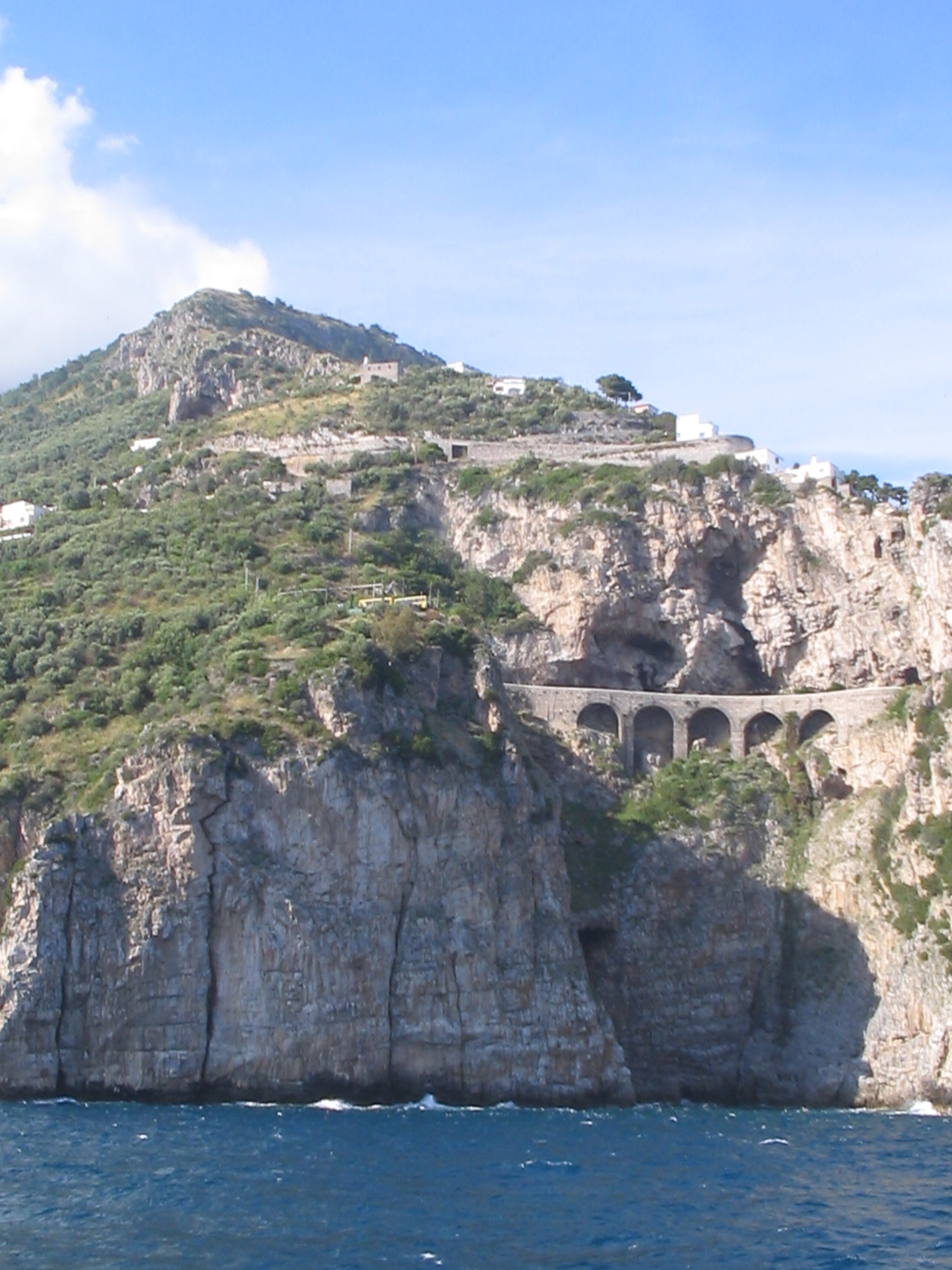
Various tasks filled the afternoon and I was tired by the end of the day. It was warm and clear outside when I emerged from the hotel, and I decided to take the ferry home rather than riding the bus. I walked down the hill from the hotel to Amalfi and bought my ticket at the tabacchi shop. I watched the kayakers play basketball as I waited for the ferry to arrive at the pier. Onboard the ferry, I selected a seat on one of the wooden benches on the top level which was open-aired. The gentle hum of the diesel engine combined with the rocking of the boat and the warm breeze almost lulled me to sleep.. I raised my hand to shield my eyes from the sun and scoured the rugged coast. Pastel-colored stucco houses and gardens cascaded down the hillsides connected by steep stone steps. I could see tiny inlets and coves where the colorful fishing boats were sheltered that hadn’t been visible from the winding roads above that I traveled on the bus. When we reached Positano, I disembarked and headed for the internet café to check email.

The view from the ferry

Then I headed back up the hill to the main piazza. (My legs were certainly getting a work out here!) Fresh tomatoes were displayed in crates outside the deli along with eggplant, zucchini, fennel, onions, garlic and a dazzling display of fresh flowers. I decided to stop and get something for a light dinner. The deli was narrow with shelves on one side stacked from floor to ceiling with paper products, pasta, olive oil, vinegar and canned goods. The refrigerated glass case on the other side held a vast array of meats and cheeses. I selected two ripe, red tomatoes, a fresh baguette, a bottle of olive oil and a wedge of soft provolone cheese. The old man behind the counter weighed and tabulated my purchases, placing them in a white plastic sack for me to carry back to the apartment.

At the apartment, I poured olive oil on a crusty slice of bread and layered it with slices of provolone and tomato. Then I topped it with fresh basil leaves. I watched television for a little while as I ate. The Italian news was followed by a soap opera that took place in a five-star hotel and restaurant in Italy. I think the bus boy had something going on with a laundry worker and “Mama” was running things in the kitchen. Only in Italy would a soap opera be centered on a kitchen!

The Savory Side of the Kitchen

           The Italian meal is a time when family and friends connect. The big meal of the day is usually around 1 or 2 PM and can last a couple of hours. It is composed of several courses and begins with Antipasti (appetizers) and is followed by the Primi Piatti (first plate—usually a pasta dish), a Secondi Piati (second plate—meat and vegetables), Insalata (salad) and is finished with Dolci (dessert.) Occasionally fruit and cheese follow the dessert. Of course, wine is served with every course and the meal is always capped off with coffee (espresso).

           The Amalfi Coast is a wedding destination. My roommates and I often saw two or three wedding parties on the weekends having their photographs taken outside one of the churches in town or on the beach. Hotel Santa Caterina was one of the few hotels that had a dining room large enough to accommodate more than 75 people. Thus, we cooked for wedding receptions at least once a week and they encompassed all of these menu courses.

           After about two weeks working for Roberto, Chef Domenico moved me to the main kitchen where I started as a prep cook – the one who does all the chopping and cutting of ingredients for the recipes that would be prepared that day- and as the saucier’s assistant. Alessandro (the saucier) was the chef who prepared seafood and pasta.  He was about 6 ft. 4 in. and looked a lot like the American actor, Elliot Gould.


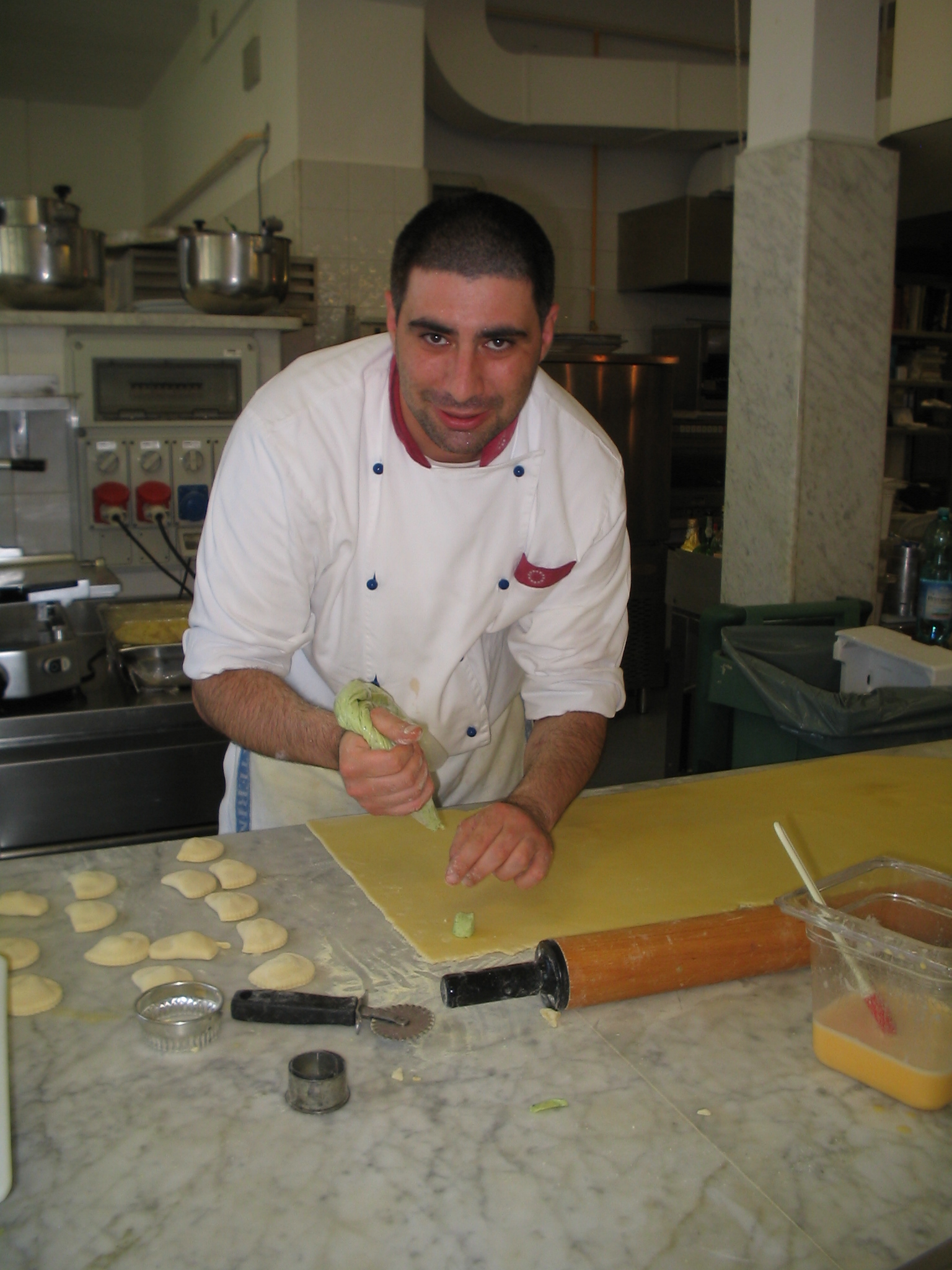
           Alessandro was busy making ravioli for the restaurant dinner menu. I watched him pipe the filling onto the dough.

           “You bring notebook and I give you recipes,” he told me. Then he assigned me some prep work for a wedding reception that was scheduled for that evening.

           The basil stems were covered with wet soil and I paused to wipe my hands on the hand towel tucked into my apron strings. I was separating the basil leaves from the stems and getting ready to wash them.  Placing the stopper in the stainless steel sink, I filled it with cool water and added the fragrant basil, swishing it around to clean off the dirt. Then I caught the floating basil with my fingers and placed it in a white plastic bin perforated with slots to allow any remaining water to drain off. I tore several sheets of paper towels off a roll on the shelf and folded them protectively over the basil before placing it in the refrigerator. 

           My next task was peeling and mincing garlic cloves. I separated the cloves and placed one on the cutting board. I laid the heavy chef’s knife on top of it and pressed downward to crush the garlic and release the skin. Then I peeled the layers of skin off, exposing the smooth, glossy garlic clove. I set it aside and picked up another one. When the peels were all removed, I collected them all on the cutting board and began cutting, using a fluid back and forth motion with the big knife, releasing the aroma of the garlic.  When I had it minced into a fine paste, I scooped it up and placed it in a plastic container, covered it with damp paper towels and put it in the refrigerator to join the basil.

           We purchased much of the fresh seafood that we used in the kitchen from local fishermen. That morning a fisherman had delivered a cardboard box with several huge sea bass, two lobsters and a large octopus. The women who washed the dishes and cleaned the kitchen during breaks and in the evening were also assigned to clean fish.  Two of them were at one of the sinks—one was scraping scales from a large fish and the other was gutting and cleaning the octopus. She wiped her hands on her blue uniform dress and took it to the Alessandro. (The dishwasher girls also bring everyone cappuccino and espresso on little trays at regular intervals and fruit punch in the afternoon. The “coffee break” takes about 20 seconds – just enough time to stir in a tiny spoonful of sugar and toss the espresso down.)


Conchetta the dishwasher


           After Alessandro finished the ravioli, he made octopus risotto for the wedding reception. Risotto is made from Arborio rice. Instead of steaming the rice in water, you slowly add broth to the rice and stir constantly until the liquid is absorbed and the rice has a creamy consistency.

            “Popoli (octopus), they are strong.” (I think he meant that they were tough.)

            He proceeded to show me how to beat the live octopus with a mallet until it was tender, although limp and mushy made a more apt description. I think it would have been easier to just drive one of those motor scooters over it a couple of times. Then he submerged it in a pot of boiling water. I didn’t know that octopus turned purple when cooked, and I was surprised that the boiling didn’t make it tough all over again. Alessandro set some aside to use for a cold seafood salad that they were serving for the wedding and sliced the remainder to sauté before adding to the risotto. 

            The whirr of the blender was added to the other sounds of the kitchen—water running, pots and pans clanging and the men laughing and chiding each other in Italian over some event I couldn’t understand.  I glanced up at the clock and realized that it was almost time to me to go home. When they are preparing for a wedding reception, the kitchen staff does not get its usual break from 3PM to 6PM.  Instead, they have to work all through the afternoon.

            They were busy frying veal and roasting huge fish for the Secondi Piati as I left at 4PM and the pastry chef, Roberto, was decorating the wedding cake.

The Bus

           My schedule was primarily driven by the bus schedule between Amalfi and Positano. As there weren’t any evening buses running, I would be working from 9AM until 4PM each day and would work 9 straight days before I would have my first Monday off.  I would only be getting one day off per week, (which is normal in Italy).  The other students were able to walk to their respective restaurants and would be working a split shift (9 to 3 and then 6-11) and would have Sunday evenings and Mondays off. 

           As I climbed up the steps from our apartment in Posiitano, I headed for the bar to order a cup of cappuccino before I caught the 7:05 AM bus. Nuts! It didn’t open until 7:30 AM. The tabacchi shop next door was a tiny alcove that sold bus tickets, maps, postcards and various sundries and it was also closed. I had purchased my ticket to Amalfi the evening before, but what was I going to do without a return bus ticket? Monthly bus ticket holders only have to get their ticket punched the first time they board the bus. I was hoping that the driver thought I was a monthly patron. 

            “Buon Giorno,” I said to the bus driver as I boarded the big green and white  SITA bus. He smiled, nodded to me and didn’t seem to notice that I had not inserted a ticket into the machine to be validated.

            Because the villages along the Amalfi Coast are cut into the steep hillsides, the road connecting them is a series of hairpin turns along the cliffs. Most of the automobiles in Italy are small, probably due to the efficient use of high-priced fuel. 

            The buses, however, are full-sized and sometimes have difficulty navigating those tight turns. It’s especially hairy when faced with another oncoming bus. Who gets to go first? It appeared to be the first one to honk his horn repeatedly. The approaching bus would stop, back up and try to pull off the road so the other bus could pass. All the cars behind him would have to back up as well. Usually at that point a couple of motor scooters would speed around the stopped buses in a hurry to reach their destinations. Then the bus tango would continue.

            Once the bus I was on passed a bus filled with Japanese tourists. They were all out of their seats, nervously watching the progress of the buses as they attempted to fit by each other. One moved forward; the other moved backwards. One moved backwards; the other moved forward. When our bus finally passed theirs, with only an inch to spare, the Japanese tourists all stood up and applauded!

            The bus ride back to Positano took about 40 minutes. When I returned to the apartment, I turned on the television to discover that the Italian soccer team was playing a championship game on TV.  Our next door neighbor Paulo’s double doors were open so he could enjoy the colorful garden of flowers and vegetables in his tiny yard. He often has friends over to play the Italian card game, Scopa, and this evening there were 3 other men seated at his dining room table watching the soccer game on TV with him. They were very animated—shouting, jumping up and down and waving their hands around—helping the Italian soccer team, Gli Azzuri (which literally means “the light blues”) with each play. When the Italian team won later that evening, the town celebrated and fireworks lit up the sky. I walked up to the piazza in the center of town that night to call Craig from the pay phone with my international calling card. I was anxious to tell him about my first couple of  days at work. It was good to hear his voice, but there was so much noise from the town celebrating that he thought I was at a party!  I tried to reassure him that I was working hard and not having any fun without him.