This spicy stew can be made without meat as well. Use vegetable stock instead of the turkey stock.
Ingredients
6 scallions, thinly sliced
1 medium green bell pepper, diced
1 tablespoon butter
1 tablespoon olive oil
3 tablespoons peeled and finely chopped fresh ginger
3 cloves garlic, minced
2 teaspoons ground coriander
2 teaspoons ground cumin
1 teaspoon crushed red pepper
1 teaspoon salt
1 teaspoon ground black pepper
2 quarts turkey stock
2 cups cubed, peeled sweet potato
1 cup creamy peanut butter
One 6-ounce can tomato paste
3 cups shredded cooked turkey, chicken or pork
One 15 ounce can diced tomatoes
1/3 cup chopped fresh cilantro (leaves and stems)
1 cup chopped lightly salted peanuts
4 scallions, thinly sliced
Optional: 1 cup chopped kale or spinach
Directions
In a Dutch oven or stock pot, cook green onions and sweet pepper in butter and hot oil for five minutes, stirring occasionally. Add ginger, garlic, coriander, cumin, red pepper, salt and black pepper. Cook and stir for 2 minutes. Add stock and sweet potato. Bring to boiling; reduce heat and simmer, covered, 10 to 15 minutes or until potatoes are tender.
In a medium bowl, whisk peanut butter and tomato paste until smooth. Gradually add one cup of the hot turkey stock from the Dutch oven and continue to whisk until well-blended.
Add turkey, peanut butter mixture, and tomatoes to Dutch oven. Cover and cook over medium-low heat 5 minutes, stirring occasionally. Stir in cilantro. Top with green onion slices and peanuts.
Recently, I returned from a trip to Africa with my daughter, Gretchen, and my granddaughter, Avery, 12. Gretchen had founded the nonprofit Global Grassroots in 2004 to help women in developing countries start their own social entrepreneurships in their communities. She was first inspired to work with marginalized women as a young girl when we lived in the Philippines.
After 20 years of working with women in Rwanda, Uganda, and Kenya, Gretchen was getting ready for a final celebration of Global Grassroots’ accomplishments and would be turning over the organization to African women to run. They would continue Global Grassroots’ legacy and would emerge with a new name – Umurage Growth. (Umurage means “legacy” in Kinyarwandan).
Our trip was also an opportunity for Avery to learn about her mom’s work and gain an understanding of the poverty and challenges faced in a developing world.
They were traveling from Seattle, and I was traveling from Boston. We met in Amsterdam for breakfast (there is one café at the airport that makes the most delicious salmon toast) and boarded our flight to Kigali. Upon arrival, we spent the first night at Hotel des Mille Collines (hotel of a thousand hills) which was the real hotel featured in the movie “Hotel Rwanda.” Being able to relax around the pool helped us adjust to the time change and catch up on our sleep.
That afternoon, our driver picked us up and we drove 3 hours west of Kigali to Volcanoes National Park in the Virunga Mountains. There are five dormant volcanoes in the park. Rwanda is very lush and green with mountains and valleys dotted with metal roofed stucco or mud brick buildings. The hillsides are terraced with hand-plowed gardens growing bananas, sweet potatoes, Irish potatoes, onions, pineapples, mangoes, casava, plantains, and papayas. The villages with markets were buzzing with people and activity. Los of people walking or biking along the side of the road, many carrying jerrycans of water, huge bags of potatoes, animal feed, charcoal or giant bunches of bananas on their heads.
We stayed a Tiloreza Ecolodge that night in a family cottage surrounded by sumptuous flower gardens. The next morning, I went gorilla trekking. You have to be 15 years or older to go, and since Avery was just turning 12, she and her mom went instead to see the golden monkeys and to the Diane Fosey Center to learn about her research with primates.
The gorilla trek started with a walk through farm fields of rough furrows of mostly potatoes and chrysanthemums that are grown for making pyrethrum, which is a natural insecticide (permethrin is the chemical equivalent with dangerous side effects). I was part of a group of 8 people led by a park ranger and accompanied by porters and trackers. Our guide taught us about harvesting potatoes, manufacturing pyrethrum and making charcoal from eucalyptus trees.
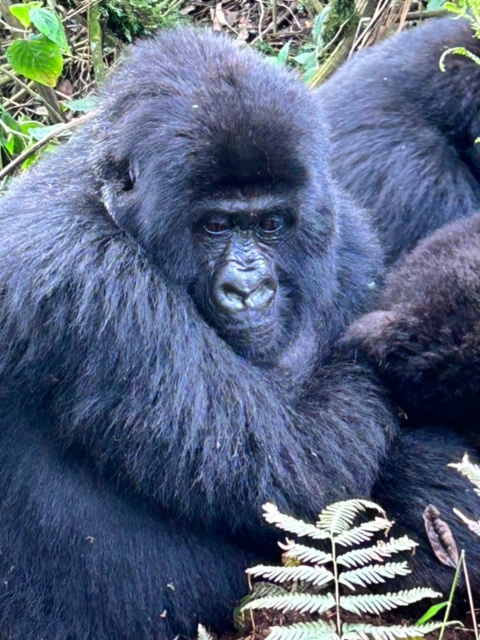
Once we finished walking along the borders of the farm fields, we crossed a rugged stile into the jungle and started a steep uphill climb. The trackers directed the guide to the group of gorillas to which we’d been assigned for the day, while using a machete to cut a path through the jungle. The porters carried our backpacks and water and helped us get through the ankle-deep mud hat sucked at our feet. Altogether, we hiked 4.3 miles uphill and spent 3 hours in the jungle, of which one hour was spent with the gorillas. We saw about 20 different gorillas including two huge silverbacks. The guide and trackers used “gorilla speak” noises to let the gorillas know that we were there and not to bother us. They also explained what to do if a gorilla approached out of curiosity or made a noise which warned it was upset – we were to kneel and stare at the ground! It was truly an amazing experience to be 4-10 feet from such majestic creatures.
That afternoon we returned to Kigali and the next day we visited a Women’s Center in a Kigali neighborhood, had an African cooking class and visited the Kigali Genocide Memorial. At the Women’s Center, women are taught literacy classes as well as how to sew or work in a hair salon. We were taken on a tour of the center and then through the neighborhood. We got to watch a woman in a hair salon do long braided hair extensions on one client. She paused just long enough to braid a strip of my granddaughter Avery’s hair too. We were also shown a section where streets had been closed to traffic to allow children to safely play or restaurant diners to enjoy their meals.
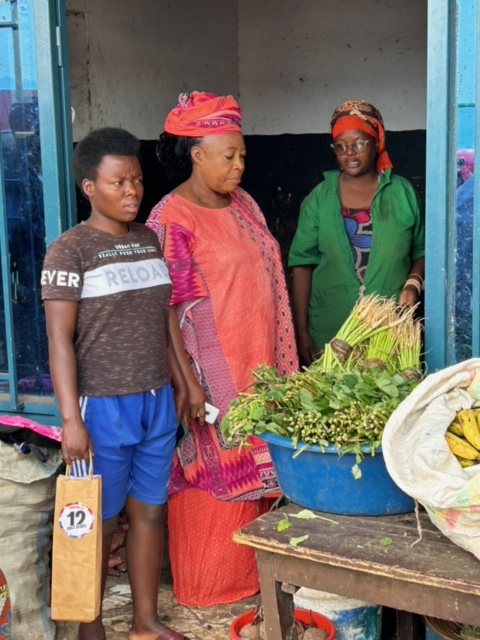
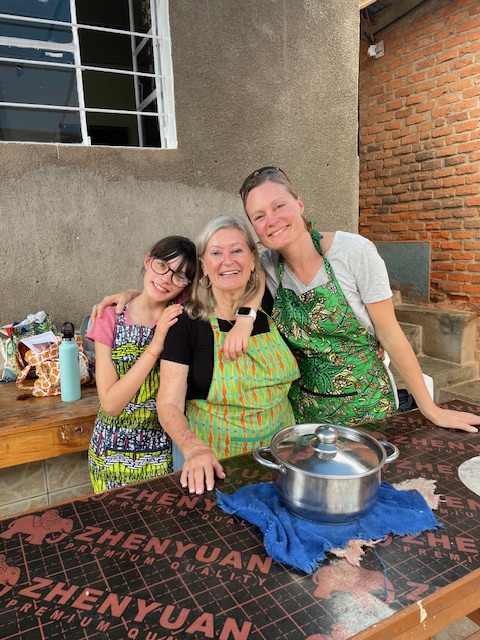
Our cooking instructor purchased vegetables for the class – tiny green eggplants, celery shoots, green bell peppers, the ripest tomatoes, dodo (amaranth leaves – like spinach), tiny carrots, red onions, cassava, sweet potatoes and plantains. Then we went to a “kitchen” in a courtyard that had a long worktable and 6 charcoal burners. We did a lot of prep work and then combined different ingredients to produce 6 dishes plus rice.
I liked the dodo with onions, bell peppers, tomatoes and crushed peanuts over rice the best. My granddaughter liked the diced cabbage with tomatoes, onions and bell peppers.
In the afternoon we visited the Kigali Genocide Memorial which, like the Holocaust Museum in Washington, DC, is an excellent historical presentation, but is also extremely disturbing and intense. You leave with sadness in your heart and even greater respect and compassion for the Rwandan people.
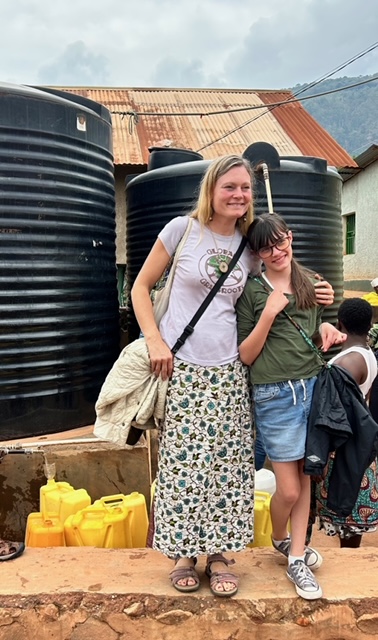
The following morning was an emotional day for me when we visited water projects funded by Global Grassroots in villages on the outskirts of Kigali. Our driver took us on deeply rutted and heavily pockmarked red dirt roads where we were able to view the new water tanks that had been installed. We walked down to the bottom of a steep hill to the slow-moving creek where the community used to collect water for their jerrycans one small scoop at a time. Did you know that a jerrycan weighs 48 pounds when full of water? And we see graceful African women balancing them on their heads as they walk uphill! The woman who oversees the water project reached out to Global Grassroots when she realized that clean water would address a lot of health issues in their community. When Covid hit, the community started making soap for sanitation. And this same woman and her husband adopted a boy who was left at the town meeting site by his family who had “rejected” him because he did not talk. She is truly an angel. You should have seen the little boy’s face when one of the women in our group gave him a matchbox car!
After lunch we went to a second water project in another village and then to a school where we were enthusiastically welcomed by the children who performed a traditional dance program for us. We had brought lots of gifts for the children including soccer balls. I think I spent the entire day on the verge of tears – it was so moving!
Our visit to Kigali would not have been complete without a visit to the expansive local market where everything from hardware and clothing to produce and meat is sold. We were focusing primarily on woven goods and the beautiful bright patterned fabrics from which the women made long skirts, colorful bags and aprons. We also went to a craft market where we saw carved wooden bowls, beaded jewelry, stoneware and jewelry made from recycled brass and steel padlocks.
The next day we left our hotel early and drove 3 hours east to Akageera National Park for a safari. Along the way we saw rice paddies, tilapia fish farms where rabbits in hutches were kept. Their droppings fell through the bottom of the hutches to feed the fish! Also, there were men who walked around with long poles with trailing cloths attached to them. Our driver explained that they were keeping the birds away from the rice & we realized they were human scarecrows! People along the shoulder of the road walked or rode bicycles carrying heavy loads – firewood, huge cloth bags of charcoal, potatoes, onions, giant stalks of freshly-cut bananas, or several jerrycans of water.
When we reached the park, we registered, paid our fees and were introduced to the man who would be our guide the next day. He gave us a briefing on what to expect from the safari and said we were to meet him at the Visitor’s Center at 6:30AM. We would be driving through the savannah for 5-6 hours. The park had lions, leopards, elephants, rhinos, giraffes, crocodiles, zebra, water buffalo. wildebeests, impala and more! As we climbed back into our vehicle and drove towards the Lodge, three graceful giraffes suddenly crossed the road in front of us and Avery was so excited!!
The Lodge was gorgeous – lots of stone and graceful architecture. In order to accommodate a lot of guests at the same time, the room rate included a buffet breakfast. Our server told us they could pack us a lunch to take with us on the safari the next morning too. (There had been one spot on the map of the park our guide had shown us that was marked as a “picnic spot.” At the time I was wondering – a picnic spot for whom? Us or the lion?)
We slept well and awoke to a spectacular sunrise. After breakfast we loaded into our vehicle (much like an oversized Landrover Defender with a roof that telescopes upward to leave an open-air gap for viewing animals), picked up our guide and headed out. We saw everything except lions and leopards. One of the other groups staying at the lodge had seen a lion, but the leopards are nocturnal and were not out and about. We did see lots of elephants and learned that the African elephant (as opposed to the Asian elephant) has ears shaped like the continent of Africa, 40,000 muscles in his trunk and lives to be 120 years old!
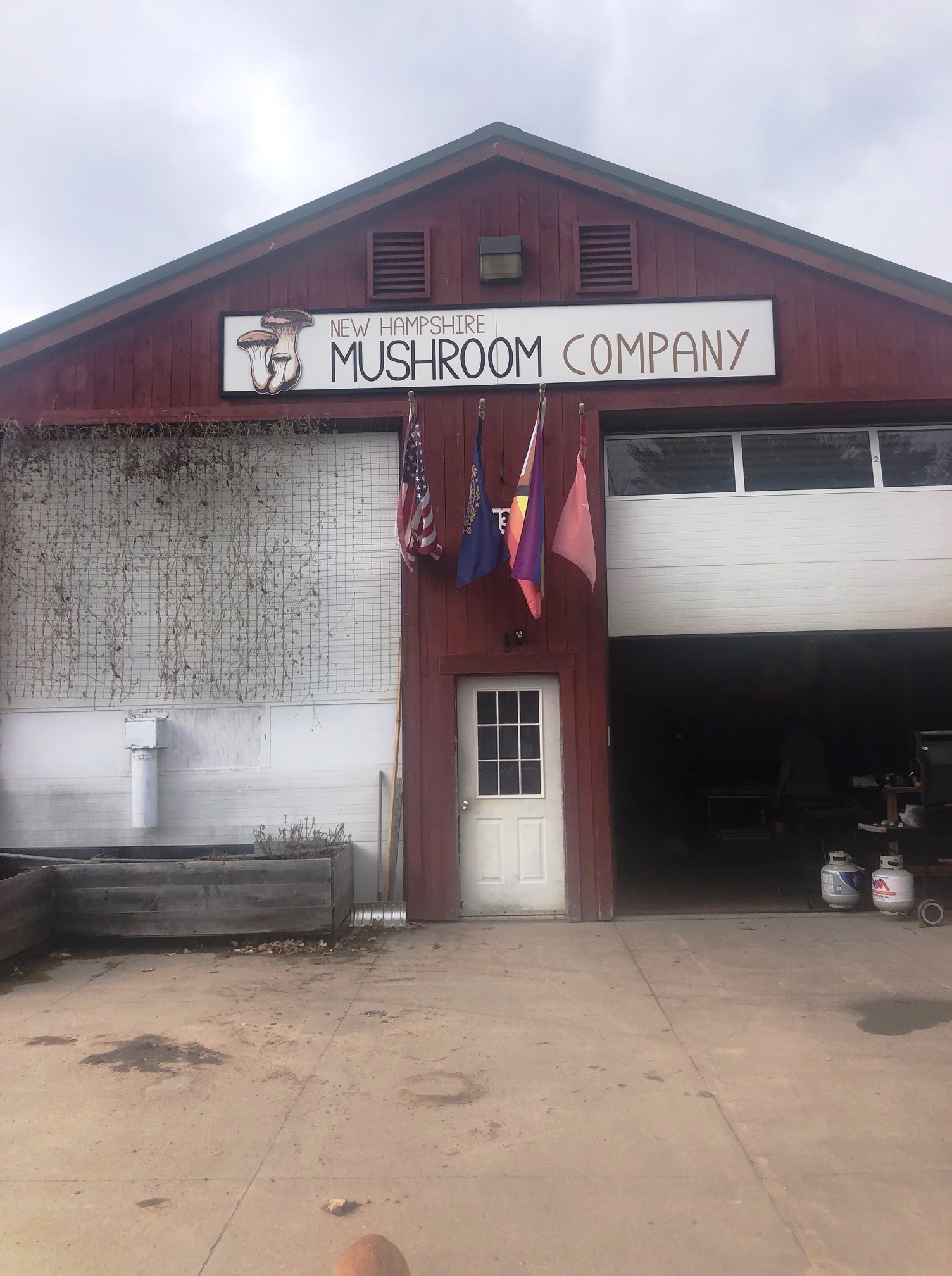
It is the beginning of spring and an appropriate time to venture out into the world again. Mask mandates have been lifted in New Hampshire and just across the Piscataqua River in Kittery Point, Maine where we live. This afternoon we traveled west of the Seacoast to Tamworth, NH and the New Hampshire Mushroom Company. Housed in a large warehouse-type building on the outskirts of town, the company cultivates specialty mushrooms that they sell fresh at the local farmer’s market or at their facility as well as to local produce suppliers. Here is a list of what was available:
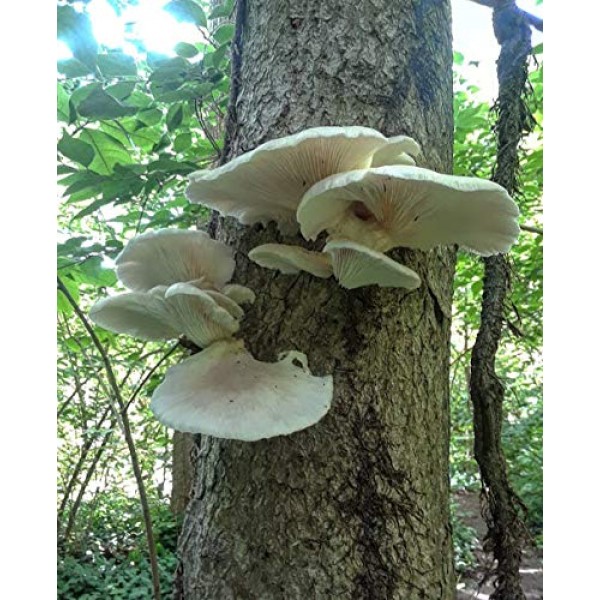
Blue Oysters- Mild in flavor with a subtle nuttiness. Great in lighter dishes, cream sauces, creamy soups, and omelets or quiche.
Black Pearl – A meaty bold oyster. Strong flavor that holds up to braising. Great with stir fried, paired with chicken, over pasta, in quiche.
King Oyster – Meaty umami flabor, robust texture similar to a button mushroom but with more flavor. Great as a main protein. Can be sautéed, grilled, pickled, smoked.
Phoenix Oyster
Phoenix & Snow Oysters – Great in lighter dishes. Over pasta, with fish, in creamy soups, or with eggs.
Lion’s Mane – Mild flavor. Great with marinara sauce. Can be used as a seafood replacement in mock crab cakes and mock seared scallops.
Elms – Strong mushroom flavor. Pairs well with heavy meats and game. Delicious in a stroganoff, a bourguignon, or on a steak or burger.
Chestnuts _ Strong nutty flavor. Great for stir fries, roasted with chicken, in gravies, or stuffings.
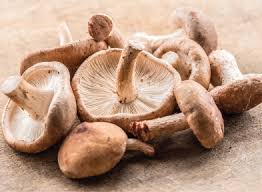
Shitakes – Strong meaty flavor. Traditionally used in Asian dishes. Great on pizza, in stir fries, or in risotto.
We had arrived on a Sunday afternoon to take a mushroom cooking class. There were approximately a dozen people present along with Eric Milligan, the owner of the company, Alec Malenfant, the General Manager, and Kristen, a young woman on their staff. Eric had founded the NH Mushroom Company in 2013 without any prior knowledge or experience. Now his scientific knowledge of mushrooms is extensive and his creative uses for mushrooms in cooking were impressive. The cooking class was even more enjoyable due to his enthusiasm and sense of humor!
He explained how the textures and flavors of various mushrooms differed. Although they are composed mostly of water, mushrooms contain 11 essential amino acids and are good sources of protein, comparable to legumes, However, heat must be applied to break them down.
Eric started by preparing a vegetable dip for us using dried Black Trumpet mushrooms. They were dried, so he rehydrated the mushrooms and used the water, which he called the “tea,” to thin a container of hummus. Then he sautéed the chopped mushrooms in White Truffle Oil and added it to the hummus. (Eric said the Fiore brand White Truffle Oil was also fantastic on Brussels sprouts, eggs or pasta.) The dip was delicious with carrots, celery and cucumber slices as well as spread on thin slices of a baguette. Eric said the sautéed Black Trumpet mushrooms are also good added to white sauce and risotto too.
Mushrooms can be used in desserts too. Eric uses mushrooms to make a “cheesecake” with a Pecan Sandie crumb crust. The filling is two parts cream cheese, one part sour cream with a squeeze of lemon, and Candy Cap mushrooms (which taste like maple syrup) are sautéed with Black Trumpet mushrooms and blended with blueberries to make a fruit compote that is served with the cheesecake.
Next Eric introduced us to dry sautéing King Oyster mushrooms. He had cut them in chunks which resembled scallops and had scored them on one side. They browned nicely in olive oil on his gas griddle and looked just like scallops! Using the same King Oyster mushrooms, he grated them with a box grater, sautéed them on the griddle and then added barbeque sauce to create mock pulled pork. When thinly sliced and added to stock, the King Oyster mushrooms also become Vegan “noodles.”
King Mushrooms as scallops, barbequed pork and hummus dip made with Black Trumpets.
The Blue Oyster mushrooms were next – torn vertically or shredded, they could also simulate pulled pork which were served in butter lettuce wraps. If you like your pulled pork sandwiches served with coleslaw, he suggested adding a dollop of mayonnaise and some Shitake mushroom power to prepared coleslaw or pickled Chestnut mushrooms as an accompaniment.
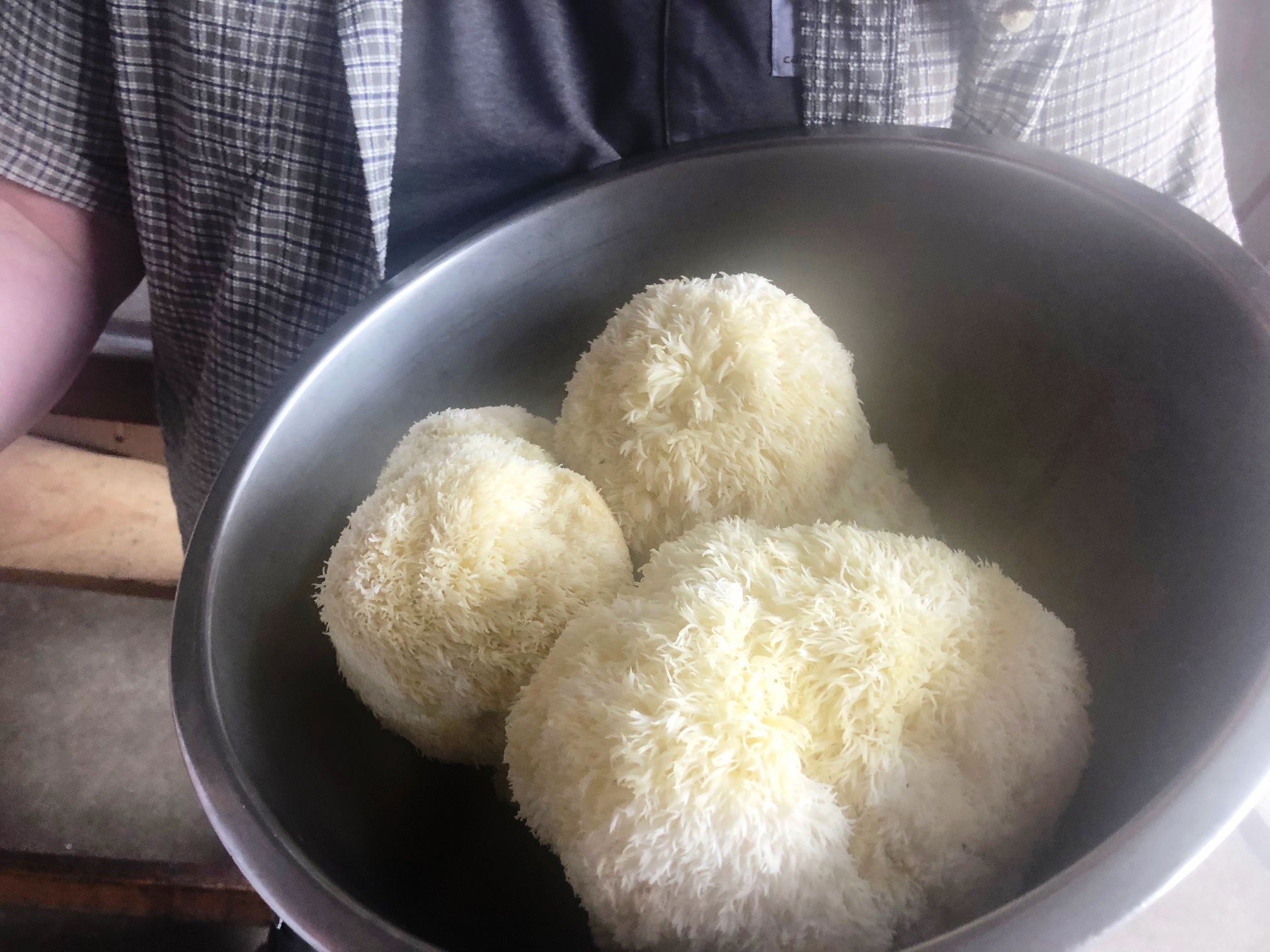
The Lion’s Mane mushrooms were perhaps the most interesting. They looked like giant cauliflowers and could be shredded to resemble crab meat and be used to make crab cakes. Eric roasted them on the grill until they turned a slightly bluish color and then he transferred them to the griddle. He said never to marinate mushrooms as they get mushy, but adding liquid to them while they grilled was okay. He made a teriyaki pineapple juice mixture which he drizzled over the Lion’s Mane mushrooms while he continued to brown them on all six sides until they looked like giant fried chicken breasts! They even tasted like chicken!
Lion’s Mane mushrooms
Lions Mane mushrooms can be sliced and sautéed with apple slices and Candy Cap Mushrooms to make a fruit dessert served with ice cream, custard or whipped cream.
Browning Lion’s Mane mushrooms on the griddle
All the participants in the class received a recipe packet that contained instructions on making Mushroom Jerky, Mushroom Duxelles, Kimshi, Foragers Popovers, and Mushroom and Olive Puttanesca served over pasta. I’m anxious to try them all!
Mushrooms are so versatile I read a recent article about one species of mushrooms that can survive on plastic and may be a solution for reducing landfill waste or helping to clean up our oceans.
I’m looking forward to the next class they offer – Top Ten WIld Edible Mushrooms.
Preheat oven to 400o. Generously grease a 9 ½ inch deep dish pie plate with shortening. You can buy graham cracker crumbs already prepared, or break 3-4 whole graham cracker squares and put in blender. Blend on high to turn into crumbs. Dump them into bowl and repeat with remaining graham crackers. Add sugar, cinnamon and melted butter to the graham cracker crumbs in bowl and mix with fork until well moistened. Using the back of a spoon, press crust into pie plate. Bake at 400 degrees for 6 minutes. While crust is baking, wash out blender to remove any remaining crumbs and combine eggs, sugar, vanilla and sour cream in blender and mix until smooth. With blender running, & add cream cheese one piece at a time until blended. (I just remove the handle and drop the cream cheese in the hole) Add melted butter and blend until incorporated. Pour into prepared crust. Reduce heat to 325 degrees and bake for 25-30 minutes. It will still jiggle in the center and will firm as it cools. Refrigerate for 2 hours or overnight. Garnish with halved fresh strawberries that have been tossed with a little sugar.
NOTE: To make this recipe vegan, use Cheerios for the crust (4 c. Cheerios will give you 1 ½ c. crumbs), double the amount of cinnamon and vegan butter for the crust. For the filling, use Tofutti sour cream and cream cheese and vegan butter. Instead of 2 eggs, put 4 Tablespoons of arrowroot in a cup and add 4 Tablespoons of cold water, stirring to dissolve. Add to filling mixture. (When baking a cake, you can use applesauce or smashed bananas to substitute for eggs, but these will not work in custard.)
In a large stockpot, sauté celery, onions and carrots in olive oil until onions are translucent. Add spinach and garlic and stir until spinach is wilted. Add chicken stock, beans, pasta, oregano and thyme. Bring to boil over medium heat. Reduce heat to simmer and prepare the meatballs.
Mix ground beef, egg, parmesan cheese and Italian seasoning in a bowl. Shape into bite-sized (one inch diameter) meatballs. Brown meatballs in 1 T. olive oil in a skillet and transfer to stockpot. Serves 6.
Note: To make this recipe vegetarian, use vegetable stock, frozen vegetarian meatballs, thawed and cut in half, and to make it gluten free, use GF orzo or rice.
2 – 15 ounce cans fire roasted diced tomatoes, undrained
1 – 15 ounce can black beans, undrained
2 – 15 ounce cans kidney beans, undrained
1 – 15 ounce can white northern or cannellini beans, undrained
2 cups vegetable stock
Garnishes: sour cream or grated cheddar cheese
Directions:
In a large Dutch oven or stock pot, warm the olive oil over medium heat until shimmering. Add the chopped onion, bell pepper, carrot, celery and 1/4 teaspoon of the salt. Stir to combine and cook, stirring occasionally, until the vegetables are tender and the onion is translucent, about 7 to 10 minutes. Add the garlic, chili powder, cumin, smoked paprika and oregano. Cook until fragrant while stirring constantly, about 1 minute.
Add the diced tomatoes and their juices, the beans and their juices, vegetable stock and bay leaf. Stir to combine and let the mixture come to a simmer. Continue cooking, stirring occasionally and reducing heat as necessary to maintain a gentle simmer, for 30 minutes.
Add salt to taste. Serves 6.
Note: You can use an envelope of McCormick chili seasoning instead of chili powder, cumin, paprika and oregano
The town of Ashland is located in Southern Oregon about 16 miles north of the California border. In the early 1820’s early Hudson Bay Company’s hunters and trappers passed through the area via the Sisikyou trail. When gold was discovered in a tributary of one of the local creeks in the 1850’s, a town was established and rapidly expanded. Schools, churches and businesses were established, including a large employer, Ashland Woolen Mills, which produced clothing and blankets from local wool. In 1871, the Post Office dropped “Mills” from Ashland’s name and in 1872 Reverend J. H. Skidmore opened a college, Ashland Academy, a predecessor of Southern Oregon University. In the 1880’s San Francisco, California and Portland, Oregon were joined by rail through Ashland.
Today Ashland is ranked in the top 10 of “The 100 Best Small Art Towns in America,” and is a cultural hot spot, with award-winning galleries, theaters and restaurants. Ashland hosts the world-famous Shakespeare Festival, the Oregon Chocolate Festival and is located in the Rogue Valley wine region. Surrounded by the Siskiyou and Cascade, it is a prime area for hiking and outdoor activities.
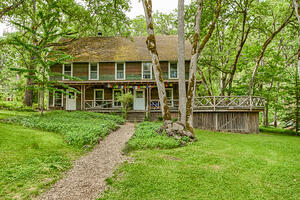
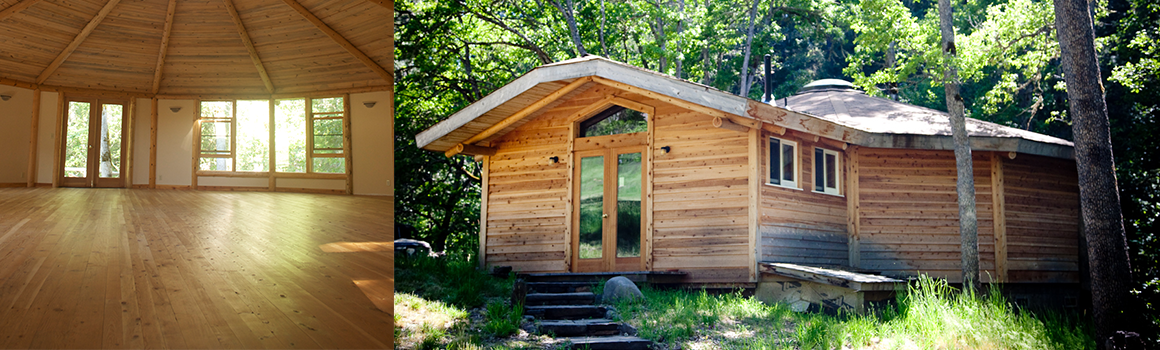
My husband and I spent two weeks in Ashland in early March, but we were not there for the amenities the charming town had to offer. We were there to cater meals for a Leadership Academy hosted by Conscious Social Change (www.conscioussocialchange.com ). Eighteen University of Virginia students had arrived to learn how inner work, mindfulness, and personal transformation could drive social innovation, systemic change and make them better leaders in the future. The retreat was held at the Buckhorn Springs Resort, a rustic lodge and collection of cabins which had once been a mineral springs healing destination for native tribes including the Rogue, Klamath, Shasta and Takilma tribes, and then for white settlers beginning in the 1890’s. The students would be housed in the historically-restored cabins, surrounded by beautiful scenery, fresh air and the babbling sound of Emigrant Creek.
Buckhorn Springs Lodge
The Meeting Room and one of the Cabins
Although I had hosted large dinner parties in the past, I don’t think I realized what I was getting into. I must admit I have greater respect for food service workers and caterers in particular now! I never could have handled this assignment without the support and energetic assistance of my husband, Craig. We were responsible for providing three meals a day to ravenous university students. Conscious Social Change wanted the menu to be vegetarian, and the meals had to meet the dietary needs of one person who was gluten-free, two vegans, and one person with a severe nut allergy! It was quite a challenge, but also immensely satisfying to meet the goals and receive so many compliments for the food we prepared. One student commented: “Thank you for making the best vegetarian food, it made me think twice about eating meat!”
So, how did we do it? We decided to set up a buffet breakfast that consisted of hard-boiled eggs, assorted yogurts (including soy yogurt), granola (no nuts), assorted packages of instant oatmeal, regular and gluten free bread and bagels, vegan butter, regular butter, vegan cream cheese and regular cream cheese, peanut butter and jelly, bananas, oranges, coffee, tea (regular and herbal) with milk, soy milk, half and half, soy creamer, and oat creamer.
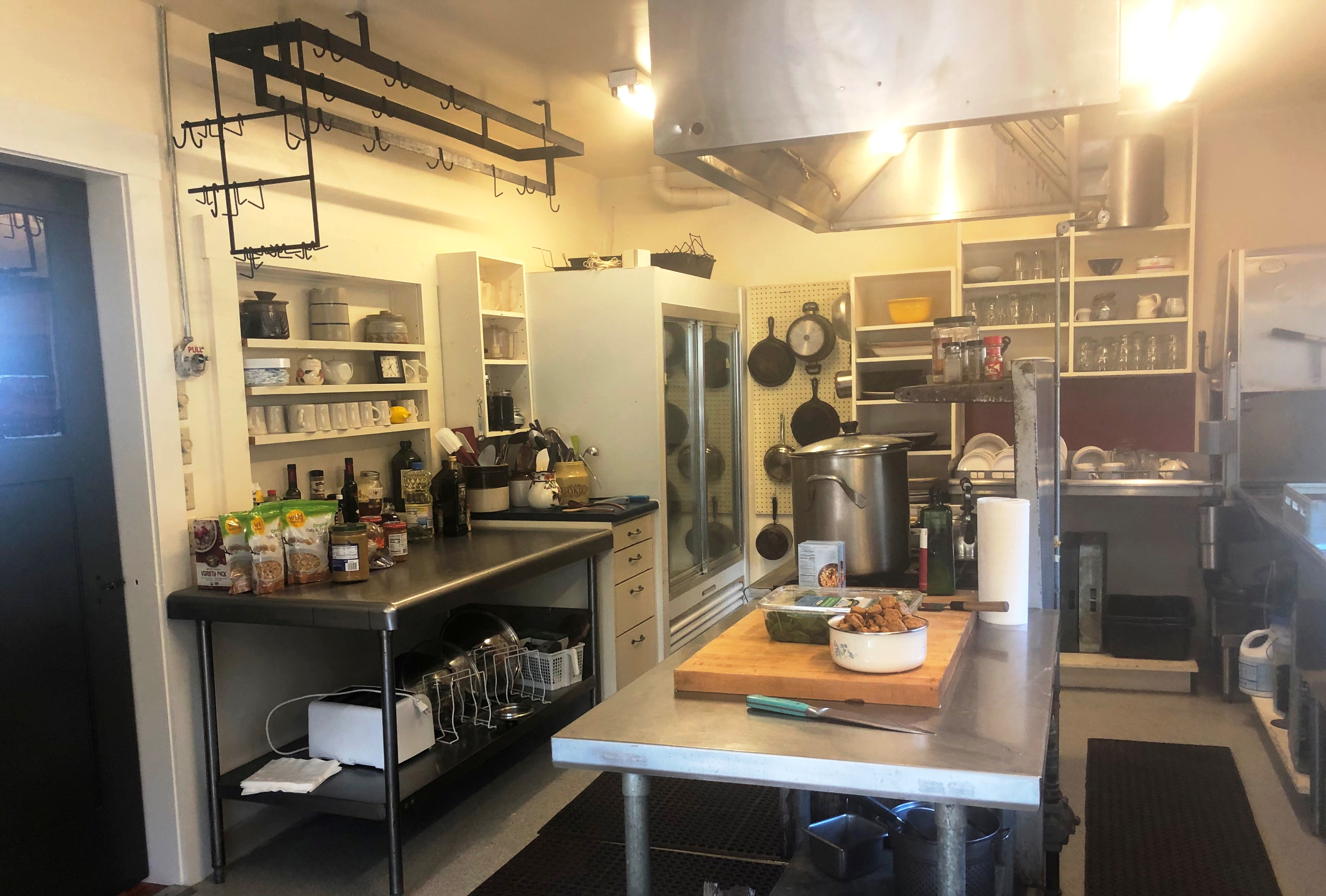
Much as I would have liked to prepare a daily quiche or gourmet muffins, this met everyone’s needs and left us free to begin prep for the rest of the day’s food. These were hungry college students! jjWe loved working in the commercial kitchen and wanted to offer hearty homemade soups for lunch each day accompanied by bread, rolls or a sandwich of some sort. Soups were Broccoli and Cheese, Vegetarian Chili, Tomato Basil Bisque, Red Potato, Leek and Corn Chowder, White Bean, Spinach and Orzo Soup with Vegetarian Meatballs, and a rich, creamy Curried Pumpkin. One girl told us she didn’t eat pumpkin, but she tried it and even came back for seconds! I think the garlic bread, grilled cheese sandwiches and the vegetarian wraps were all big hits.
Commercial Kitchen
Our evening meals consisted of Spinach and Mushroom Lasagna with a Tossed Salad and Vegan Cheesecake for dessert, Sweet Potato and Black Bean Burritos with Corn on the Cob and Chocolate No Bake Cookies for dessert, Mushroom Bourguignon over noodles (or gluten-free penne) with a tossed salad and Apple Cranberry Crisp for dessert, Asian Stir Fry with Broccoli, Bell Peppers, Snow Peas, Mushrooms, and Water Chestnuts over Jasmine Rice with Banana Egg Rolls for dessert, Ratatouille over Brown Rice with a tossed salad and Peach Crisp for dessert, Beyond Beef Cheeseburgers with Sweet Potato Fries and the Chocolate No Bake Cookies for dessert, and we ended with a Make Your Own Pizza night with assorted ice cream and sorbets for dessert. Bless my husband for slicing more than 20 pounds of mushrooms that week and washing mountains of dirty dishes because the commercial dishwasher was not working.
We loved interacting with the students and it was a great experience!
2 cups diced conch meat (see how to prepare below)
1 cup all-purpose flour
2 teaspoons baking powder
¼ teaspoon Cayenne pepper
1 egg
½ cup milk
¼ cup diced onion
½ cup diced green bell pepper
½ cup diced red bell pepper
2 cloves garlic, minced
Salt and pepper, to taste
Peanut oil for frying
Lime, quartered
Cocktail sauce
Directions
If you have purchased whole conch, place it on a cutting board and using the rough side of a meat mallet, pound the conch to about 1/4″ thickness. Then use a very sharp chef’s knife to dice the conch meat into 1/4″ pieces. Transfer the chopped conch to a large mixing bowl.
In a large pot or deep fryer, heat oil to 365°F. Mix the flour, baking powder, egg, and milk in a large bowl. Season with salt, pepper, and cayenne pepper. Mix in the chopped conch meat, onion, green and red bell pepper, and garlic until well blended. Drop rounded tablespoons of the mixture into the hot oil and fry until golden brown. Drain on paper towels. Serve with a wedge of lime and cocktail sauce on the side.
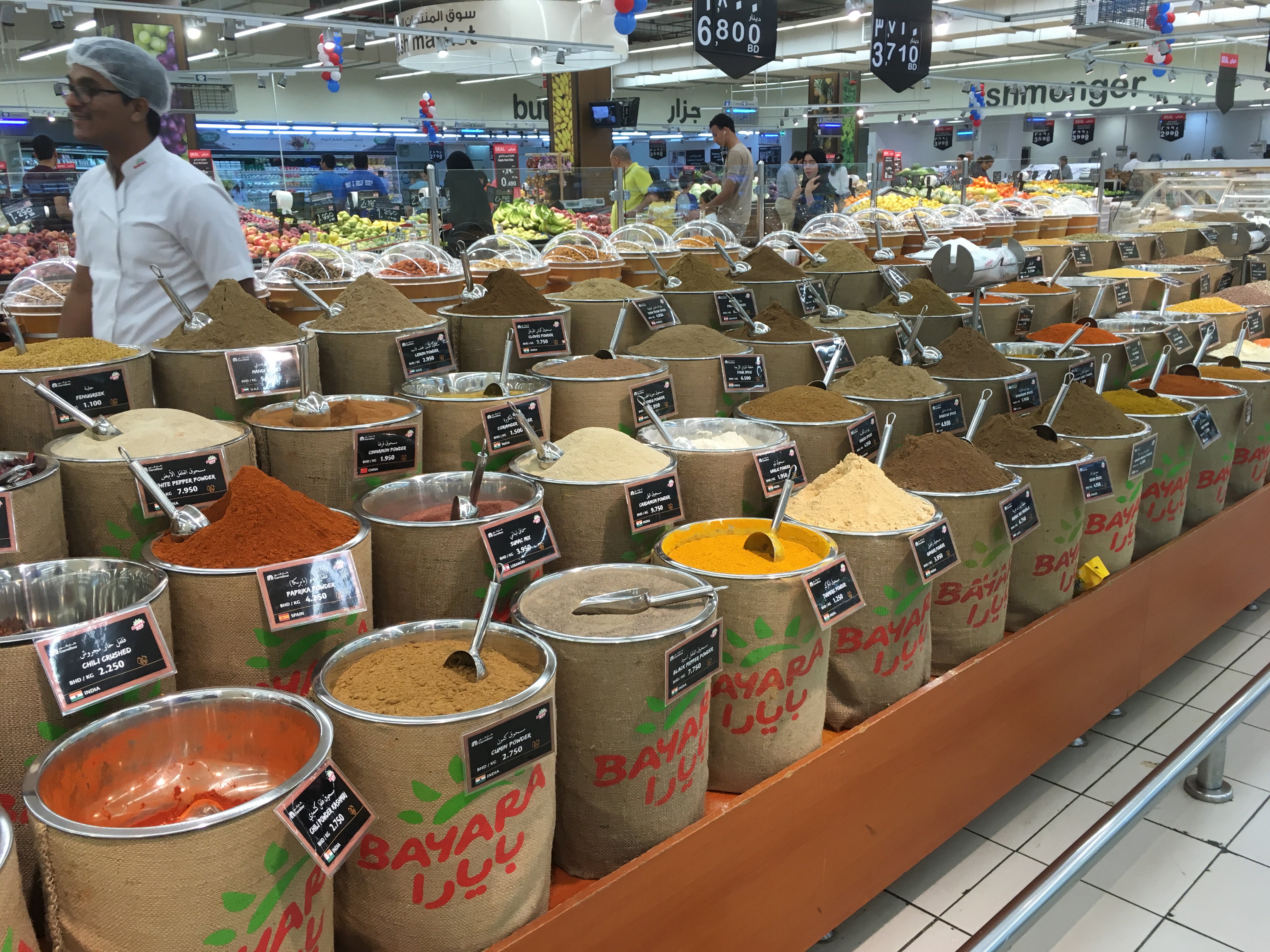
Bahrain is an international port and, as such, imports goods from all over the Middle East, India, Pakistan and Africa. Each restaurant in Manama featured a different cuisine and the food markets offered a dazzling selection of bins filled with spice, shelves stocked with oils, dates, honey and staples from around the world.
Spices
But what did the average Bahraini eat? Every meal was served with flatbread, and various small plates of egg dishes, meat dishes (usually chicken or lamb), vegetables (I liked the white beans with cilantro which were very spicy), hummus, tahini, and curries. These dishes were shared among diners. The flatbread was torn into smaller pieces and a spoonful of one of the other items was placed on the flatbread and rolled up. Diners ate this morsel with their right hand, utensils being reserved for serving. The population is predominantly Muslim and alcohol is not served except in larger establishments and hotel restaurants. Thus, diners drink water or fruit juices with their meals and follow the meal with Arabic style (strong) coffee or chai tea.
The area is subject to dust storms of very fine, white silt, which was probably the reason there was not any “street food” per se as there is in other cities of the world. The famed “shwarma” was sold at many establishments along the sidewalk where doors could be slid open to reveal the juicy, marinated chicken and lamb roasting on a spit. This Middle Eastern variation of a wrap was available everywhere for the equivalent of $3 US.
The vast array of available spices is incorporated into most menus. The following recipe is for the Chicken Machboos that we made in our cooking class.
Bahraini Chicken Machboos
Ingredients
¼ c. rose water
¼ t. saffron threads
2 T. melted butter
¼ c. canola oil
Whole spices:
3 star anise
2 black lemons*
2 cinnamon sticks
5 whole cloves
2 bay leaves
5 whole cardamom
Vegetables:
2 medium onions, diced
2 or 3 garlic cloves, minced
½ t. ground ginger
½ c. fresh cilantro, chopped
½ c fresh dill, chopped
1 medium tomato, diced
Remaining spices:
1 T. salt
½ t. black pepper
½ t. cinnamon
½ t. ground cardamom
½ T. turmeric
½ T. paprika
1 T. curry powder
1 t. cumin
1 2-3 lb. chicken, quartered
2 c. basmati rice
4 c. water
Green chili (optional)
Directions
Pour rosewater into a measuring cup and add saffron threads. Cover with plastic wrap and soak for 4 hours or overnight.
In a heavy stock pot or Dutch oven, heat butter and oil over medium high heat. Add whole spices and sauté until you can smell the aroma. Then add onions, garlic and ginger. Fry for about 5 minutes or until golden brown. Add cilantro and dill and stir for one minute. Add the fresh tomato and mix until it softens. Add remaining spices and mix for 3-4 minutes.
Add the chicken and fry for 5 minutes on both sides to lightly brown. Add 4 c. water and bring to boil. Simmer for 40-45 minutes until chicken is cooked. Remove chicken from pan and set aside.
Rinse rice with cool water until it is clear. Drain. Add to stockpot. There should be 3 c. water in the stockpot for the 2 c. rice. If not, add more water. Bring to boil and then reduce heat and simmer for 10 minutes. Add the rose water and saffron. Place chicken on top of all other ingredients and continue cooking for 10-15 minutes or until rice is cooked. Garnish with lemon slices. Serves 4-6.
Thailand is the only country in Southeast Asia that has not been colonized by Europeans. Thus, its cuisine is authentic and has only been slightly influenced by bordering countries or traders.
Thai cuisine is very spicy and focuses on dishes which are well balanced in four areas – sweet (usually palm sugar or coconut milk), salty (fish sauce and salt), sour (lime in several forms and tamarind) and spicy (chilies). Meals served in restaurants are accompanied by a quartet of sauces brought to the table – fish sauce, sliced chili peppers in rice vinegar, dried chili flakes, and palm sugar. Rice is served at most meals, (usually jasmine rice, but also sticky or glutinous rice) and sometimes noodles. Cucumbers are often served to cool the palate. I was told recently that additional ways to counter the spiciness is to add more rice, add sugar, or drink more beer!
Thai food was traditionally eaten by the right hand while seated on cushions on the floor, but today most Thais eat with a fork and large spoon. The fork is held in the left hand and is used to scoop or push into the spoon which is held in the right hand. Chopsticks are reserved only for noodle dishes.
The Thai pantry can be stocked from items available in the international aisle at a grocery store or a local Asian market. Lo’s Seafood in Portsmouth, NH carries Thai canned goods (coconut milk, fish sauce, tamarind paste), kaffir lime leaves, lemongrass, galangal, fresh chilies (bird’s eye chilies or very tiny chilies are hotter than larger chilies), Thai basil and cilantro. Green, yellow and red curry pastes (hottest to mildest, respectively) can be made from scratch or purchased already prepared.
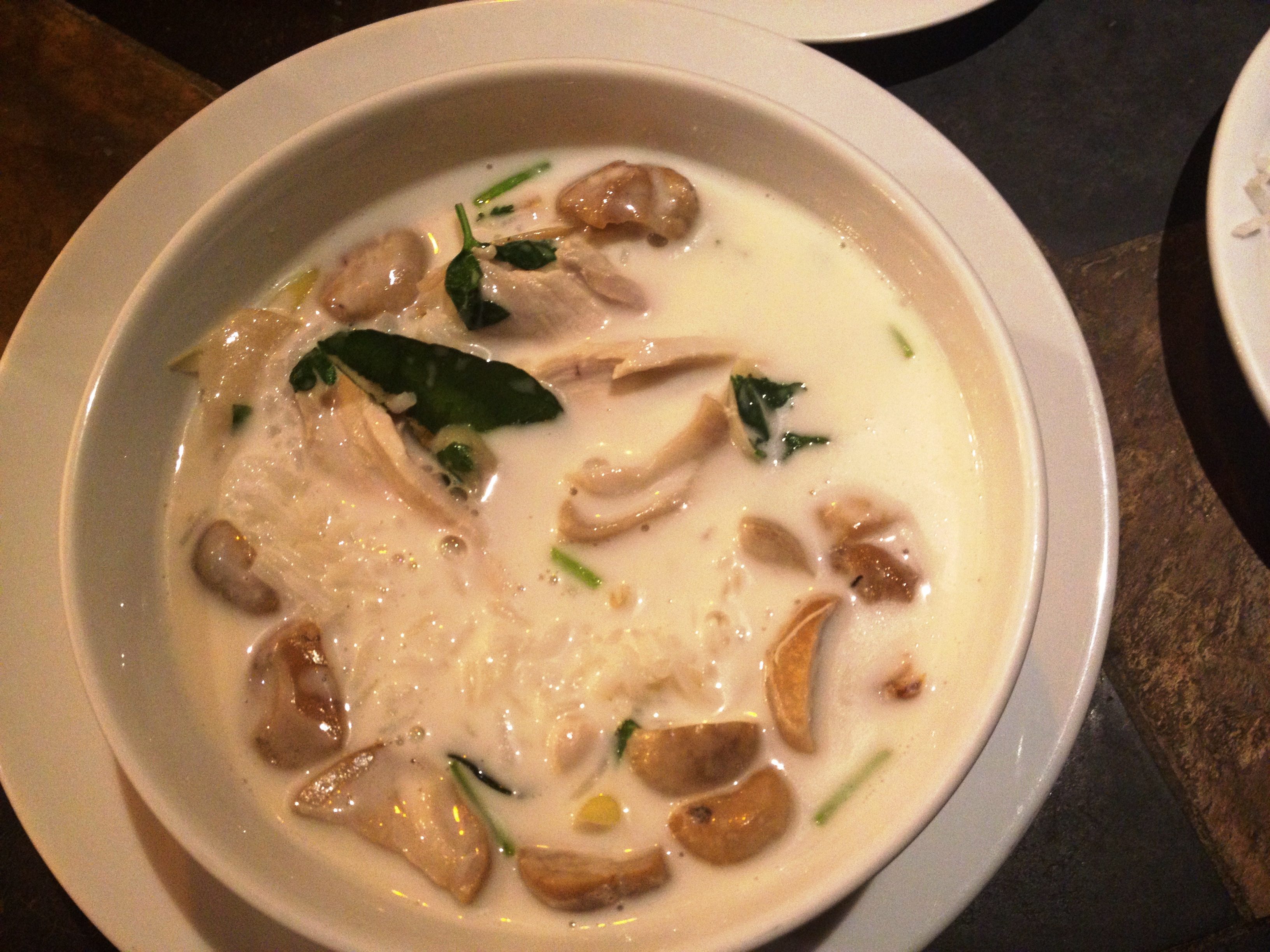
The following recipe for Chicken Coconut Milk Soup is one which we prepared at the Thai Farm Cooking School while I was in Thailand recently.
Tom Kaa Gai (Chicken Coconut Milk Soup)
Ingredients:
½ c. water
¼ cup of peeled, thinly sliced galangal or ginger
1 stalk of lemongrass, sliced into one-inch pieces
½ cup halved grape tomatoes
½ cup sliced mushrooms
1-5 bird eye’s chili peppers
1 chicken breast, sliced thinly and cut into bite-sized pieces
1 can coconut milk
2-3 kaffir lime leaves
1 stem of cilantro, finely diced
3 sliced scallions
1 T. fish sauce or soy sauce
½ teaspoon light brown sugar
Pinch of salt
2 teaspoons of lime juice
Directions:
Combine water, galangal, lemongrass, tomatoes and mushrooms in a saucepan over medium high heat and bring to boil. Remove stems from chili peppers and crush open by banging down with your palm on the flat side of a heavy knife. Add chili peppers, coconut milk and chicken pieces to broth. Reduce heat to medium and cook until chicken is milky white all the way through. Fold kaffir lime leaves in half along spine and remove spine of each leaf to release flavor. Add to soup with cilantro, scallions, fish sauce, sugar and salt to taste. Continue to cook over medium heat for 5 more minutes to intensify flavor. Finally add lime juice (soup will be too bitter if lime juice is added too early.) Lemongrass pieces, kaffir lime leaves, chilies and galangal or ginger root should be removed prior to serving as they are all too tough to chew. Serves 2.











 theadmiralschef