Knife Cuts and More

Although I had been cooking for my family for over 30 years, I had learned a lot in the basic cooking classes that I took at Anne Arundel Community College’s Hospitality, Culinary and Tourism Institute (HCAT) in Maryland.

The kitchen facilities at HCAT were relatively new and would be the envy of any home cook. Down the center of the room six ten-burner gas stoves were lined up, along with a microwave, two salamanders (broilers), a deep-fat fryer, an indoor grill, a griddle, convection oven, steamer, tilting skillet,  flanked by gleaming, stainless steel tables.  Along one wall there was a sink for hand washing and three sinks for washing dishes: one filled with soapy water was for washing, one with clear, hot water for rinsing and a final sink filled with a cool solution was for sanitizing. The other wall held wire shelving stocked with herbs and spices, a variety of rice, pasta, grains, vinegars and oils, and pots and pans. Bins on one end of the room were filled with different types of flour and sugar. On the other end of the room was one large “walk-in” refrigerator which revealed fresh produce, meat and poultry and led to a walk-in freezer. Smaller “reach-in” refrigerators were located in one corner and held milk, eggs, cheeses and condiments. There was also a broom closet filled with mops and pails, a laundry room for kitchen linens and I noticed a large first aid kit on one wall.  (I wonder how often they needed it.)

We learned the principle of mise en place, or assembling everything you need for a recipe before you begin. How many times have you gone to make chocolate chip cookies to discover that you’re out of sugar? Mise en place guarantees that it doesn’t happen, especially in a restaurant kitchen.

We also learned basic knife cuts. The reason for making uniform knife cuts is to promote even cooking and uniform appearance of food ingredients.  Remember that Campbell’s vegetable soup you ate as a kid? We had purchased a “knife kit” as part of the required tools for the course.  It was a black fabric case with pockets in it for the chef’s knife, boning knife, paring knife and the steel for honing knives. We were taught how to sharpen the knives and how to hold them correctly to allow us to make very precise cuts rapidly, smoothly and without cutting off any fingers.  We took classes in basic cooking techniques, baking (The science of baking is fascinating.  Did you know that recipes are referred to as “formulas?”), garde manger (the cold kitchen), food science, international cooking, cost controls, and purchasing.

In our cooking classes which were generaly three to five hours long, the students were divided into groups and assigned certain recipes to prepare. The dishes would be critiqued by our intructor-chef at the end of class on appearance, taste and presentation. But first, we had to practice our knife cuts.  Our chef usually assigned about four or five different knife cuts which he had to approve before we could begin our cooking. For instance, the chef might ask us to do four ounces of julienned carrots or three ounces of large diced potatoes.

Did you know that a fine julienne cut (think of a match stick) is only 1/16 in x 1/16 in x 2 in?  And if you cut it into cubes, it becomes a brunoise cut. That’s really small. We learned a number of other cuts including the tourner (pronounced “toor-nay” – a two-inch long football-shaped food product with seven equal sides and flat ends). You are supposed to be able to exercise the cuts smoothly, rapidly and not injure yourself in the process. I actually tournered (is that a verb?) potatoes for dinner for my husband one night, but it took all afternoon. I’m sure I whittled off more potato than I kept. My husband was very impressed, but I’m not sure I’d ever do it again – certainly not for more than one person.

Grilled Crab and Swiss Sandwich on Rye

Ingredients:

1 lb. jumbo lump crabmeat, cleaned

1 stalk celery, diced

1 t. Old Bay seasoning

1/4 c. mayonnaise

6 slices Swiss cheese

12 slices of marble rye bread

Butter, softened

Directions:

Prepare crab salad by combining crabmeat, celery, Old Bay seasoning and mayonnaise in a bowl. Divide among 6 slices of bread.  Top each with one slice of Swiss cheese.  Top each one with another slice of bread which has been spread with a small amount of mayonnaise.  Spread softened butter on the outside of the sandwiches and grill on medium heat until golden brown.

Easy Gazpacho

Ingredients:

2 1/2 c. can beef stock

2 ½ c. V-8 or tomato juice

2 T. diced green onion

1 clove garlic

¼ t. Tabasco

½ t. salt

Dash fresh ground pepper

1 c. diced green pepper

1 c. diced cucumber

1 c. diced tomato

Directions:

Peel and slice garlic clove lengthwise and spear on a toothpick.  Combine all ingredients in a large bowl and chill at least 4 hours. Serves 6.  This is a refreshing soup to take sailing or to the beach in a large thermos!

The Pillsbury DoughboyTM

The concept of becoming a chef was filled with both anxiety and anticipation.

When I first enrolled in culinary arts classes, I noticed that the course descriptions in the college catalog stated, “In addition the student must provide the required uniform, a white chef coat, scarf, apron, checkered kitchen pants, black closed toe shoes and a chef hat.” A mandatory orientation session for all Hospitality, Culinary Arts and Tourism majors was scheduled for the next day and we had to wear our uniforms. I inquired about where we were to get this “uniform” and learned that the campus book store, located in the Student Center, sold uniforms along with all of the text books and supplies I would need for my classes.

The bookstore was noisy and crowded when I arrived. Long lines of students were queued in front of the registers, their arms laden with heavy texts. They chatted amicably with friends, listened to iPods or text messaged on their smart phones as they waited their turn to check out. The store aptly sold textbooks grouped by subject matter, a small selection of current paperback books, art supplies, spiral notebooks, college t-shirts and memorabilia.  In addition, there was an assortment of required equipment for various majors – stethoscopes and blood pressure cuffs for the nursing students, brushes, easels and large, black portfolios for the art students, and knife kits and uniform essentials for the culinary arts students. The uniform components were stacked in cubbies against the wall.  I picked up one of the plastic shopping baskets by the door and snaked my way through the crowd. My eyes were wide with wonder. I saw the white, cotton aprons (one size fits all), the black and white checkered pants with elasticized waist (I picked a medium but wondered if that was “men’s” or “women’s”), the triangular neck scarf, a hat (which resembled a deflated mushroom), a white cotton apron with long ties and a front pocket, and then saw the white chef’s jackets.

Oh, my – a real chef’s coat!  It was stiffly starched, carefully folded and lovingly (I was sure) packaged in cellophane.  I put down my shopping basket and lifted a package off the shelf.  The sticker on the package read:  “Traditional Chef Coat – 100% Pima Cotton.”  It had a short, upright collar; long, cuffed sleeves; a reversible, double-breasted panel on the front with two rows of fabric covered buttons; and a deep double pocket on the sleeve for a digital thermometer and a marking pen.  It was sublime!  I added it to the other uniform components in my shopping bag and headed for the registers.

Later that evening, I decided to try everything on and see how I looked as a real chef.  Let’s see, first I pulled up the pants and tucked in my white t-shirt.  Then, I put on the chef’s coat.  The double-breasted front allowed you to reverse the jacket and place a clean, white front on the outside and hide the one splattered with food and grease.  Next, I tied the neckerchief around my neck according to the directions that came with it – much like a man would tie his necktie.  Apparently, the neckerchief is designed to keep perspiration from your face from dripping into the food you prepare.  A professional kitchen is HOT with all those ovens and gas stoves going and everyone rushing around.  I donned the apron over my chef’s coat and wound the strings around myself to tie them in the front.  This allows the chef to hang a hand towel on the apron strings.  I pulled black socks onto my feet and slipped them into the sturdy, black clogs that would protect my feet from any spills and keep me from slipping on a damp kitchen floor.  Last, I placed the chef’s hat on my head and beamed!  I walked proudly over to the full-length mirror in our bedroom and my wide smile faded.

I looked exactly like the Pillsbury DoughboyTM!  I was so bundled up that I appeared to be as wide as I was tall.  I didn’t look like a professional chef at all and my misery was apparent in my facial expression.  A big, fat tear rolled down my cheek. It was going to be embarrassing to show up in this outfit for the orientation the next day, but there wasn’t anything I could do.

The next morning, I repeated my dressing regimen without enthusiasm.  I felt so self-conscious and awkward when I got out of the car in the college parking lot and waddled to the auditorium.  As I entered the room, there were already a dozen students in attendance.  Our instructors, all executive chefs from local restaurants, were milling around a long table on the stage.  Then, I realized that they ALL looked rather portly wearing their chef’s jackets!  I lifted my chin, stood a little taller and made my way to one of the seats on the aisle.

As the next two years progressed, I became more comfortable in my chef’s clothing and my chef’s jacket, in particular, became a symbol of pride in what I was to become – a professional chef!

Coffee Toffee Pie

Ingredients:

Pastry shell:

½ package pie crust mix

¼ c. light brown sugar, firmly packed

¾ c. finely chopped walnuts

1 square unsweetened chocolate, grated

1 t. vanilla

Filling:

½ c. (one stick) butter, softened

¾ c. sugar

1 square unsweetened chocolate, melted and cooled

2 t. instant coffee

2 eggs

Topping:

2 c. heavy cream

2 T. instant coffee

½ c. confectioner’s sugar

Directions:

Preheat oven to 375oF.  In medium bowl, combine piecrust mix with brown sugar, walnuts and grated chocolate.  Add 1 T. water and vanilla.  Using a fork, mix until well blended.  Turn into a well-greased 9 inch pie plate. Press firmly against the bottom and side of pie plate.  Bake in 375oF oven for 15 minutes.  Cool pastry shell in pie plate on wire rack.  Meanwhile, make filling.  Cream butter and sugar and mix on medium speed for five minutes until light and fluffy.  Blend in cool melted chocolate and instant coffee.  Add one egg and beat five minutes.  Add remaining egg and beat five minutes longer. Turn filling into baked pie shell and refrigerate, covered with plastic wrap, overnight.

The next day, make the topping.  In mixing bowl, combine cream with instant coffee and confectioner’s sugar.  Refrigerate mixture, covered for one hour.  Remove from refrigerator and beat until stiff.  Spoon over filling. Garnish with chocolate curls or grated chocolate, if desired.  Refrigerate for at least 2 hours prior to serving. Serves 8.

Just Desserts

We all like to try new recipes, and I’m certainly no exception.  Although I favor savory cooking versus baking and desserts, a good meal deserves a sweet finish – something that will make your guests close their eyes and say “ahhh” with each bite.  I attempted a new recipe for a layered mocha pie at one of the first dinner parties we held for another Navy couple.  Little did I know that our guest had worked as a pastry chef prior to joining the Navy!  I had forgotten to thoroughly grease the pie plate and couldn’t get slices of the pie out of it for serving.  Using a spatula, I eventually served a crumbled chocolate crust and the chocolate mousse/coffee flavored whipped cream in one big SPLAT! Nevertheless, the Coffee Toffee Pie was delicious.

Red Pumpkin Ravioli with Four Mushroom Sauce

Ravioli con Zucca Rosso

(Red Pumpkin Ravioli)

Ingredients:

Filling:

2 c. fresh Zucca rosso (red pumpkin), small dice (or you can use 1 c. canned pumpkin)

1 T. olive oil

½ c. Ricotta cheese

¼ c. Parmesan, grated

¼ c. Smoked provolone, grated 2 T. fresh basil, chiffonade

Pasta Dough:

1 c. flour

1 c. semolina flour

3 eggs

Egg wash:

One egg, beaten

Water

Directions:

Sauté pumpkin in olive oil until soft (if you are using canned pumpkin, you can eliminate this step). Stack basil leaves, roll and slice thinly into slivers. Combine all ingredients for filling and set aside while you make the pasta dough.

Using dough hook, combine all ingredients on low speed. Dough will be very sticky. Use disposable gloves to form dough into a ball and knead on flour-dusted surface until it is smooth. Cut a portion off with sharp knife. Dust with semolina flour and roll out pasta dough into a thin sheet using a rolling pin, pasta maker or pastry sheeter. Brush with egg wash. Place teaspoons of filling on dough at regular intervals. Place another sheet of pasta dough on top. Carefully, seal around the filling with your fingers. Using a heart-shaped cookie cutter, cut out the raviolis. Check seal again to remove any air bubbles. Pasta may be frozen on a cookie sheet and transferred to a zip loc bag for later use at this point. For service, boil gently in 4 quarts of salted water for 4-5 minutes or until they float. Recipe makes 30-40 pieces of ravioli, depending on size of cookie cutter. Can freeze any extra pasta dough that is not used. Serve with Sage Butter Sauce or Porcini Mushroom Sauce.

Sugo ai Quattro Funghi

(Four Mushroom Sauce)

Ingredients:

1 large clove garlic, minced

2 T. Olive Oil

8 oz. Shitake Mushrooms, sliced

1 large Portobello mushroom, diced

½ c. dried Porcini mushrooms, rehydrated & diced

8 oz. Button mushrooms, sliced

1 T. fresh thyme, chopped

1 T. fresh basil, chopped

½ c. chicken broth

Salt & Pepper to taste

2 scallions, sliced

Directions:

Sauté the garlic in a frying pan, add mushrooms and cook over low heat for 5 minutes. Add thyme, basil, and chicken broth and cook for another 5 minutes. Season to taste with salt and pepper. Spoon sauce over ravioli. Garnish with scallions. Serves 6.

What is Your Passion?

           When I first got married, I didn’t know how to cook.   My parents had grown up during the Great Depression and had learned how to manage without a lot of extras. My father was a journalist in the Navy with four children, and it was still difficult for them to make ends meet with such a large family.  Our meals were pretty plain – a small portion of meat, starch (usually potatoes in some form) and a canned vegetable. School lunches (we could never afford to buy lunch, and subsidized lunches weren’t available then) consisted of a peanut butter and jelly sandwich on white bread and two vanilla wafers. We brought milk in a thermos, which still managed to warm by the time we ate lunch. We never had after school snacks, and we never had dessert after dinner. We were a close knit family, though, as Navy families tend to be.  Our parents loved us dearly and we didn’t recognize the fact that we were lacking anything.

           I met my husband when I was attending college and he was going through the Navy flight program in Pensacola, FL.  I still lived at home and he lived in the bachelor officers’ quarters (BOQ). He had graduated from the US Naval Academy where they had a dining hall that fed them and people that took care of their laundry. Those same amenities were offered at the BOQ, so neither one of us had really lived on our own and neither one of us had learned how to cook.

           I still recall the first meal that I prepared for my husband in our tiny rented apartment. I purchased ground beef, kidney beans and chili seasoning and was proud of the pot of chili awaiting him when he returned home from a day of flying.  At the time, I didn’t realize that you could enhance a bowl of chili by serving it over rice or by adding grated cheddar, diced onions or sour cream as a topping.  I could see a look of doubt on his face, but he never complained.

           I have been a Navy wife – recognized as “the toughest job in the Navy” – for over 40 years.  During my husband’s Navy career, we moved 29 times and traveled to 24 countries. I’ve enjoyed learning about the history and culture of the places we have visited and sampling the regional cuisine. During our travels and at each of our duty stations, I’ve taken occasional cooking classes and have requested recipes from hostesses and chefs.  When my husband was attending the US Naval Test Pilot School, the TPS wives formed a gourmet group that met once a month and hosted a theme dinner.  Three or four of the wives would decide on the menu and do the cooking, and they would tally up receipts for food purchases that would be divided among those participating. It was a great way to challenge our culinary skills while enjoying an inexpensive dinner with friends.

           When my husband retired from the Navy and accepted a position as an aerospace engineering professor at the US Naval Academy, he suggested I find something to do (I think to keep me out of trouble). Our three children are grown and live out of the area, and I wasn’t working.

           “What is your passion?” he asked me.

           No one had ever asked me that before.  What is my passion? Webster’s Dictionary defines passion as “a strong or extravagant fondness, enthusiasm, or desire for.” I had done a lot of things over the years, but I didn’t think I felt strong enough about anything to label it as my passion. After thinking about his question for a couple of days, I finally decided that I really enjoyed cooking.

           “Then, take some cooking classes,” he suggested.

           I searched the local newspaper, telephone book and then the internet to find cooking classes offered in Anne Arundel County.  Then I discovered the Culinary Arts program at Anne Arundel Community College in Arnold, MD and began taking classes part time. I was nearly 60 years old and my fellow students were in their late teens and early twenties. I thought I knew how to cook before I started the program, but I realize now that my experiences had only touched the tip of the iceberg.

A Day in the Life of a Culinary Intern

A rooster was crowing somewhere.  The room was still dark, but the sky outside the small rectangular window high on the wall above my bed had lightened to a pale gray.  I opened one eye and tried to focus on the clock—5:45 AM.  I was tired and the idea of getting up early for work didn’t seem as much like a good idea as it had the night before.

I dragged myself out of bed and went down the hall to the bathroom.  After dressing and applying my makeup one eye at a time (the mirror on my bedroom wall was too small to see anything more), I pinned my hair up.  Picking up my chef’s uniform on its hanger, I quietly slipped out into the cool morning air without waking my roommates. Their shifts also started at 9 AM, but they were all working in restaurants in Positano and could get up later and still have time to walk to work. I needed to catch the bus to Amalfi at 7:05 AM.

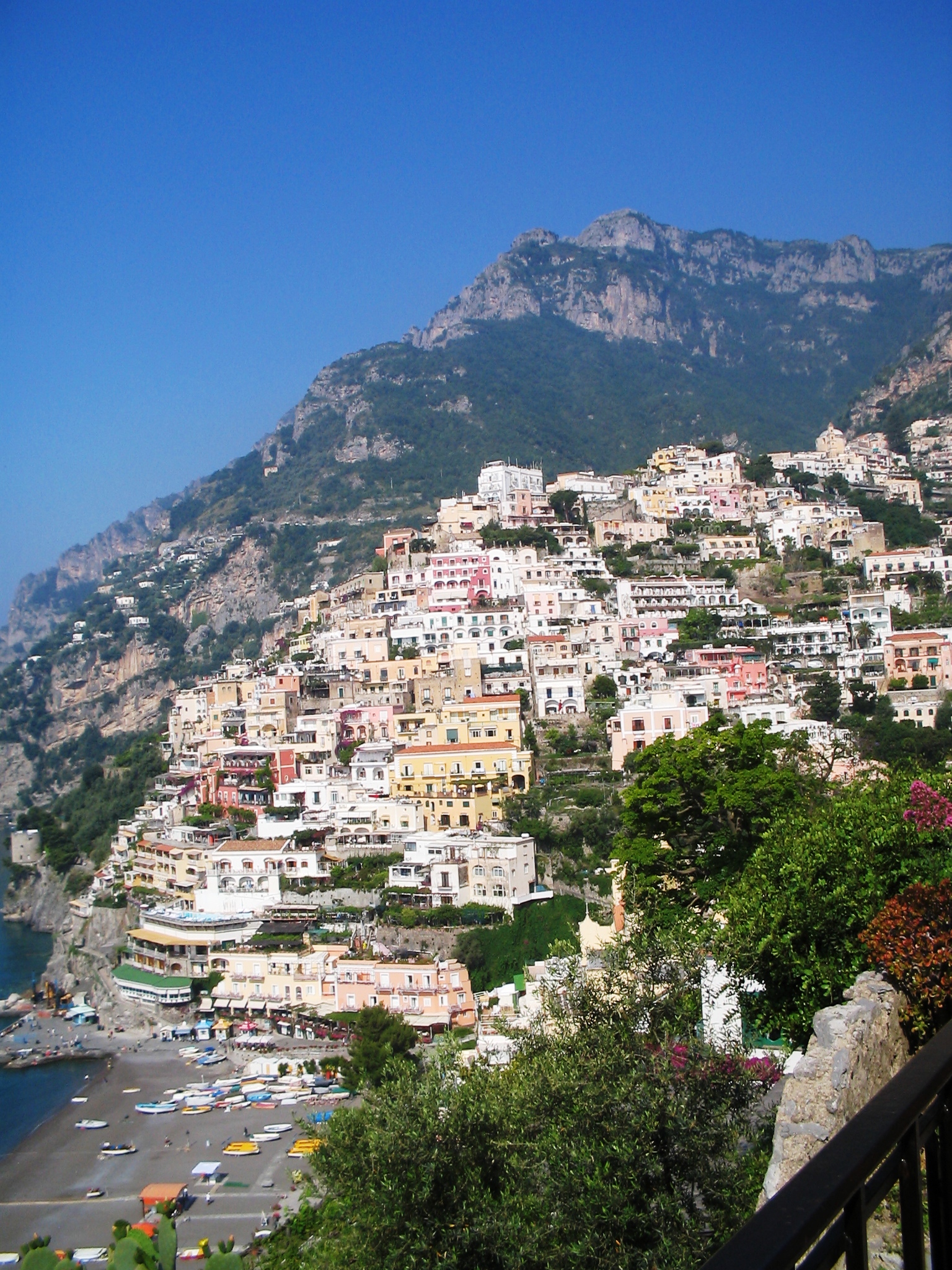
The costiera amalfitana, orAmalfiCoast, is located on the southern edge of theSorrentoPeninsula south ofNaples and is distinguished by the majesticLattariMountains that plunge to theTyrrhenian Sea. The town of Positano, where I was living for the summer with three other culinary interns, was known as la citta verticale, the vertical city.  It was impossible to walk anywhere without encountering hundreds of stone steps. Faded pastel-colored stucco houses perched on the cliffs with the older, bougainvillea-draped homes at the top. Laundry danced from balconies in the sea breezes.  Narrow cobblestone passageways tumbled down the hillside, lined with expensive shops selling hand-made leather sandals, brightly-colored beach ware, hand-painted ceramics and products, like Limoncello liqueur, derived from the huge, aromatic lemons for which the area is known. Candles with a sweet citrus scent and bars of lemon-scented soap perfumed the air. There were numerous hotels and restaurants, a deli, a coffee shop, a couple of Tabacchi shops and an internet cafe near the bottom of the village along the gray sand beach.

Our apartment sat in a hollow in the center of the village, accessed by walking down more than 200 wide stone steps. (That meant that to leave the apartment, you had to walk UP all those steps!) As I left for the bus stop, I passed a man sweeping steps outside a barber shop.  Small garbage trucks stopped to collect trash bags set outside the doorways of houses and shops. A stout woman with a watering can showered brightly colored flowers in clay pots on her balcony.

Buon giorno,” greeted a woman walking her dog down the hill.

“Buon giorno,” I replied as I trudged up the hill.

The sea was calm – a darker gray than the horizon.  There were a couple of fishermen in their bright blue and yellow rowboats just off shore. The sun flashed a smile as it peeked around the mountains to the east. I reached the stone bench at the bus stop just as I heard the rumble of a diesel engine and the big, blue SITA bus came to a screeching halt in front of me.

Because the villages along theAmalfiCoastare cut into the steep cliffs, the road connecting them is a series of hairpin turns along the cliffs.  The hotel where I was working in the town ofAmalfiwas curved to fit the winding road and clung to the hillside several stories down between the road and the sea. It was cream-colored stucco with dark green trim adorned with window boxes spilling with colorful flowers.  A brass plaque to the left of the front door identified it as a “Five Star Hotel” and a “Member of the Small Leading Hotels of the World.” A cluster of motor scooters, yellow, silver, blue and white, huddled by the employee entrance to the left of the main door.

I entered the open doorway and went down three flights of stairs (Ugh! I’m going to have to walk back up) to the basement where I shared a locker with one of the dishwashers.  The room was the size of a coat closet.  I quickly changed into my uniform, took a deep breath and climbed the steps to the kitchen.

Pots and utensils banged as a woman gathered them from the end of a stainless steel table and took them to the sink where hot water was streaming into a sink of soap bubbles.

Buon Giorno,” greeted Roberto, the pastry chef.  The whirr of the large floor mixture added to the cacophony of the kitchen as he added eggs to the homemade mayonnaise that he was making.

Buon Giorno, Roberto.”

I stepped aside as a delivery person pushed a dolly stacked with crates of vegetables into the kitchen.  He handed an invoice to the head chef who began checking the items to make sure the order was complete.  An animated discussion ensued, the chef’s voice sounding like a staccato typewriter as he questioned the delivery man about the freshness of the fennel and eggplant.

A waiter entered through the swinging door from the dining room with a tray of dirty dishes.  He placed it on the counter, gathered up a basket of fresh croissants and quickly returned to the dining room.

Everyone in the kitchen was Italian which challenged my language skills. They were always shouting across the room to each other and dramatically waving their hands around. I only understood part of what was being said and sometimes felt like I was living in a Godfather movie!
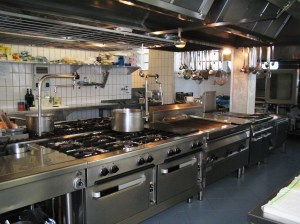
I retrieved a fresh apron from a drawer in the kitchen and tied it around my waist. In the mornings we did a lot of prep work.  At first I thought they were giving me all the tomatoes to dice, carrots and potatoes to peel and zucchini to shred with the mandoline because I was the intern or apprentice (or maybe a woman? InItaly, the kitchen is a man’s domain. Only our dishwashers were female).  But I looked around and noticed that everyone else was also dicing and slicing ingredients for the day’s recipes.

This morning I was separating the basil leaves from the stems and getting ready to wash them.  When I was finished with the basil, I minced the garlic and then diced cherry tomatoes for the tomato sauce and grated fresh Parmigiano cheese. My final task for the morning was to peel and cut carrots into a julienne cut (think shoestring potatoes – very thin slivers).  I was told to fill an entire bucket with carrots which took most of the morning.

The kitchen staff at the hotel was organized more like the French brigade system. Instead of having a number of line cooks, they were all station chefs and were assigned specific duties in the kitchen based on either the cooking method or category of items to be produced.  The grill station chef was responsible for all grilled items and also prepared the employee lunch for the day, which we ate at 11:30AM before the hotel lunch service began. The Executive Chef (we just called him “Chef”) posted the daily specials on the bulletin board along with that day’s employee menu.  The employee lunch was generally some type of meat, a vegetable and pasta of the day.  Today’s meal was breaded chicken cutlets, green beans and macaroni and cheese. The hotel fed about 60-70 employees for lunch and another 20 at dinner time.

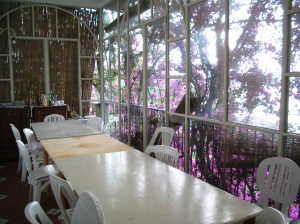
The chef’s lunch room was an enclosed porch just off the kitchen.  The table was always set with a white table cloth and paper napkins.  There were platters of fruit, baskets of fresh bread and bottled water – both acqua naturale and gassata—on the table.  Only the chefs sat on the porch. The other hotel employees used a lunchroom that was down one flight of stairs in the basement.  I was the only woman among 15 men at the chef’s table and feeling a little self-conscious, I ate quickly and returned to the kitchen.
In the afternoon, I helped one of the chefs, Alessandro, make pasta dough using a dough hook and a huge mixer that sat on the floor.  He placed the big ball of dough on the “pastry sheeter.” This was a piece of heavy equipment that resembled a wood planer, if you’re familiar with woodworking equipment.  It was about 6 feet long and sat on the floor.  It had a waist-high 18 inch wide conveyer belt on it.  In the center was a “press” that you could adjust downwards.  You controlled the forward or backward movement of the conveyor belt with levers on the side of the machine.  Each time the dough moved along the conveyor belt, you lowered the press a little more so that you ended up with a thin sheet of pasta dough when you were finished.  (The Pastry Chef also used the sheeter to make “laminated” doughs—these are the ones with layers and layers of dough alternating with butter that are used to make flaky croissants.)

Next Alessandro laid the long, thin sheet of pasta dough on a large marble table.  He showed me how to brush it with an egg wash that would help the ravioli seal when we added the top layer.  (I had made ravioli several times at home, but they always came apart.  Perhaps this egg wash was the secret step I was missing?)

Chef used a spatula to put pumpkin ravioli filling into a pastry bag and then piped teaspoon-sized portions of the filling at intervals along the pasta dough.  Alessandro placed a second sheet of dough over the first and let me cut heart-shapes around each “lump” of filling with a cookie cutter.  We pressed them together around the edges to seal each piece of ravioli and placed them on a metal sheet pan.  Then the sheet pan was put into a flash freezer that would freeze them solid in just a couple of minutes.  The finished raviolis were stored in a plastic container in a regular reach-in freezer until needed for service.

I glanced up at the clock and noticed that it was almost time to go home. We were always so busy that the day passed quickly. Removing my soiled apron, I tossed it into the laundry basket and dashed down the steps to the locker room. I changed into my regular clothes and hurried back up the steps to street level, emerging breathless from the hotel just as the bus arrived.  The bus ride along the winding coast road took about 45 minutes and was crowded with tourists. Back in Positano, I maneuvered down the cobbled alleyways to the internet café near the beach to check my email from home and then headed back up the hill to the main piazza.  (My legs were certainly getting a work out here!)

Fresh tomatoes were displayed in crates outside the deli along with eggplant, zucchini, fennel, onions, garlic and a dazzling display of fresh flowers. I decided to stop and get something for a light dinner. The deli was narrow with shelves on one side stacked from floor to ceiling with paper products, pasta, olive oil, vinegar and canned goods.  The refrigerated glass case on the other side held a vast array of meats and cheeses.  I selected two ripe, red tomatoes, a fresh baguette, a bottle of olive oil and a wedge of soft provolone cheese. The old man behind the counter weighed and tabulated my purchases, placing them in a white plastic sack for me to carry back to the apartment.

At the apartment, I unpacked my purchases and drizzled olive oil on a crusty slice of bread.  I layered it with a slice of provolone and a juicy slice of tomato for my dinner and took it outside to eat on the porch. We had two metal chairs that sat on our porch which was shaded by lemon trees and overlooked our yard of evenly-spaced basil plants (no grass).  It was a very peaceful place to read and I needed to review my Italian language before the next day at work.